054
Digital Art, Photograhy and CGI (Peter Weibel & Michael Jostmeir)
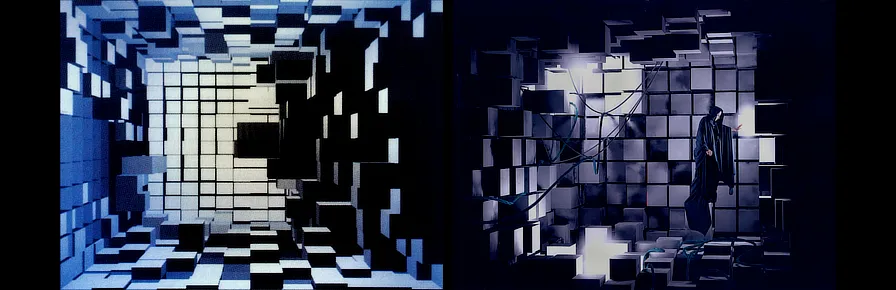
The advent of computer-generated imagery (CGI) (1) marked a period of research and innovation in new creative processes for visual communication. The first 3D software allowed for the creation of basic shapes in light and dark tones, which could be numerically manipulated and displayed electronically (2) on a screen. Peter Weibel (3), for instance, was one of the pioneering artists who utilised and promoted these new processes.
The advancement of personal computers simplified digital technologies, which had initially been accessible only to major film productions (4). These creative processes were linked to image management, the numerical proportionality of photographic techniques, and the use of imagination and fantasy in the conceptual components of images. At Photokina (5) 2008 (Cologne, Germany), Michael Jostmeir (6) presented CGI technologies for educational fields and professional photography applications.
References
Texts
- 1. 003 Pioners en les noves etapes de la imatge / Pioneers in the new stages of image
- 2. 096 L’evolució del 3D i 4D en la imatge electrònica / The evolution of 3D and 4D in electronic imaging
- 3. Sommerer, C. & Mignonneau, L. (eds.) (1998) ART @ SCIENCE. Springer: Wien. P. 175.
Peter Weibel. Professor for Media Arts at the Academy of Applied Arts in Vienna, Austria. “We know that the common link between both the technological/visual media of film and photography and the art media of painting and sculpture lies in the way visual information is stored. These material carriers make it extremely difficult to manipulate that information. Once recorded, visual information is irreversible. The individual image is unmoving, frozen, static. Any movement is, at best, illusion. The digital image represents the exact opposite. Here each component of the image is variable and adaptable. Not only can the image be controlled and manipulated in its entirety, but far more significantly, locally at each individual point. In the digital media all the parameters of information are instantly variable. Once a photograph, film, or video has been transferred into digital media its variability is dramatically improved. In the computer, information is not stored in enclosed systems, rather it is instantly retrievable and thus freely variable. Through this instant variability, the digital image is ideally suited for the creation of virtual environments and Interactive Computer Installations. Here, the character of the image changes radically. For the first time in history the image is a dynamic system”.
- 4. Fotogramas: Martin, J.P. (2022). [en línia]. "Entonces lo digital era el demonio": 40 años de 'Tron' y su apuesta pionera e incomprendida del CGI. Disponible a: <https://www.fotogramas.es/noticias-cine/a40511783/tron-pelicula-curiosidades/> (Data consulta: 1 de febrer de 2024)
In 1982, CGI technology was used for the first time in the film Tron (directed by Steven).
- 5. British photographic history: Pritchard, M. (2020). [en línia]. Photokina ends after 70 years. Disponible a: <https://britishphotohistory.ning.com/profiles/blogs/photokina-ends-after-70-years> (Data consulta: 1 de febrer de 2024)
- 6. Simon-Ohm Hochschule: Jostmeier, M. (2008) CGI. Computer Generated Imaging: Photokina 2008. Nürnberg: Georg-Simon-Ohm Hochschule. University of Applied Sciences. P. 5.
Michael Jostmeir. Professor CGI at Georg Simon-Ohm University of Applied Sciences, Faculty Design. Nuremberg. “[…]This technique provides us the avenue to express abstract contents, imaginations and visions. As in the real term object and material photography and the presentation in advertising, within virtual presentation consistency of surface and material, sharpness gradient, light and reflection play a decisive role. The photographical conditions are crucial. The concepts “photorealistic visualization” and “virtual photography” are not yet documented, but they correlate to the indicating medium “photography”. The description of materials and surfaces, volumes and space demands knowledge in the handling of light. “Photography” means to write and to describe with light in Greek. Here the competence of the media and photo designer is necessary […]”.
Images
- Sommerer, C. & Mignonneau, L. (eds.) (1998) ART @ SCIENCE. Springer: Wien. P. 176.
Peter Weibel. Zur Rechtfertigung der hypothetischen Natur der Kunst der Kunst und der Nicht-Identität in der Objektwelt, 1992 .Frame of an interactive computer installation (Galerie Tanja Grunert, Köln).
- Simon-Ohm Hochschule (2008). CGI. Computer Generated Imaging: Photokina 2008. Nürnberg: Georg-Simon-Ohm Hochschule. University of Applied Sciences. P. 34.
PEOPLE. Study work "Menschen in virtuellen Raum", Faculty of Design, Nuremberg, 2008. Work by students of Professor Michael Jostmeir, with a photographic studio portrait (with a green chroma key background), merged in digital post-production on a CGI-designed background.