054
Art Digital, fotografia i CGI (Peter Weibel i Michael Jostmeir)
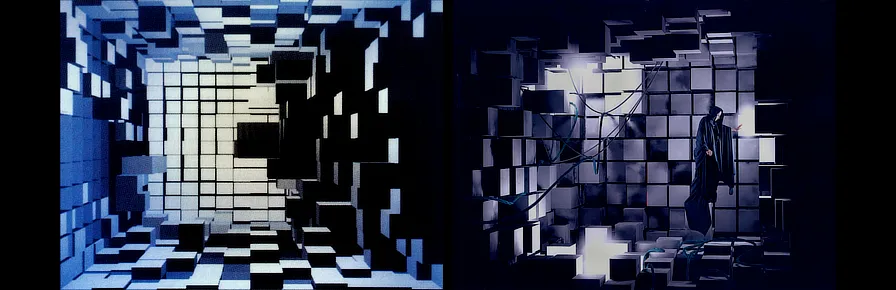
Els inicis de la imatge generada per ordinador (CGI) (1) van marcar una etapa de recerca i innovació en nous processos creatius per a la comunicació visual. Els primers programaris 3D van permetre crear formes bàsiques, amb llums i ombres, que es podien manipular numèricament i visualitzar electrònicament (2) en una pantalla. Peter Weibel (3) va ser un dels artistes pioners en utilitzar i divulgar aquests nous processos.
L’evolució dels ordinadors personals va simplificar l’accés a les tecnologies digitals, que en els seus orígens únicament havien estat a l’abast de les grans produccions cinematogràfiques (4). Aquests processos de creació estan relacionats amb l’image management, la proporcionalitat numèrica de les tècniques fotogràfiques i la incorporació de la imaginació i la fantasia en la construcció conceptual de les imatges. A la Photokina (5) 2008, celebrada a Colònia (Alemanya), Michael Jostmeir (6) va presentar les tecnologies CGI aplicades a l’educació i a l’àmbit professional de la fotografia.
Paraules Clau
Referències
Textos
- 1. 003 Pioners en les noves etapes de la imatge / Pioneers in the new stages of image
- 2. 096 L’evolució del 3D i 4D en la imatge electrònica / The evolution of 3D and 4D in electronic imaging
- 3. Sommerer, C. & Mignonneau, L. (eds.) (1998) ART @ SCIENCE. Springer: Wien. P. 175.
Peter Weibel. Professor for Media Arts at the Academy of Applied Arts in Vienna, Austria. “We know that the common link between both the technological/visual media of film and photography and the art media of painting and sculpture lies in the way visual information is stored. These material carriers make it extremely difficult to manipulate that information. Once recorded, visual information is irreversible. The individual image is unmoving, frozen, static. Any movement is, at best, illusion. The digital image represents the exact opposite. Here each component of the image is variable and adaptable. Not only can the image be controlled and manipulated in its entirety, but far more significantly, locally at each individual point. In the digital media all the parameters of information are instantly variable. Once a photograph, film, or video has been transferred into digital media its variability is dramatically improved. In the computer, information is not stored in enclosed systems, rather it is instantly retrievable and thus freely variable. Through this instant variability, the digital image is ideally suited for the creation of virtual environments and Interactive Computer Installations. Here, the character of the image changes radically. For the first time in history the image is a dynamic system”.
- 4. Fotogramas: Martin, J.P. (2022). [en línia]. "Entonces lo digital era el demonio": 40 años de 'Tron' y su apuesta pionera e incomprendida del CGI. Disponible a: <https://www.fotogramas.es/noticias-cine/a40511783/tron-pelicula-curiosidades/> (Data consulta: 1 de febrer de 2024)
L’any 1982, es va utilitzar per primera vegada la tecnologia CGI en la pel·lícula Tron (dirigida per Steven)
- 5. British photographic history: Pritchard, M. (2020). [en línia]. Photokina ends after 70 years. Disponible a: <https://britishphotohistory.ning.com/profiles/blogs/photokina-ends-after-70-years> (Data consulta: 1 de febrer de 2024)
- 6. Simon-Ohm Hochschule: Jostmeier, M. (2008) CGI. Computer Generated Imaging: Photokina 2008. Nürnberg: Georg-Simon-Ohm Hochschule. University of Applied Sciences. P. 5.
Michael Jostmeir. Professor CGI at Georg Simon-Ohm University of Applied Sciences, Faculty Design. Nuremberg. “[…]This technique provides us the avenue to express abstract contents, imaginations and visions. As in the real term object and material photography and the presentation in advertising, within virtual presentation consistency of surface and material, sharpness gradient, light and reflection play a decisive role. The photographical conditions are crucial. The concepts “photorealistic visualization” and “virtual photography” are not yet documented, but they correlate to the indicating medium “photography”. The description of materials and surfaces, volumes and space demands knowledge in the handling of light. “Photography” means to write and to describe with light in Greek. Here the competence of the media and photo designer is necessary […]”.
Imatges
- Sommerer, C. & Mignonneau, L. (eds.) (1998) ART @ SCIENCE. Springer: Wien. P. 176.
Peter Weibel. Zur Rechtfertigung der hypothetischen Natur der Kunst der Kunst und der Nicht-Identität in der Objektwelt, 1992 . Fotograma d’una instal·lació interactiva per a ordinador (Galerie Tanja Grunert, Köln).
- Simon-Ohm Hochschule (2008). CGI. Computer Generated Imaging: Photokina 2008. Nürnberg: Georg-Simon-Ohm Hochschule. University of Applied Sciences. P. 34.
PEOPLE. Treball d’estudi "Menschen in virtuellen Raum", Facultat de Disseny, Nuremberg, 2008 . Treball d’alumnes del professor Michael Jostmeir, amb un retrat d’estudi fotogràfic (amb un fons de croma verd), fusionat en postproducció digital amb un fons dissenyant amb CGI.