060
Cloud images and emotional equivalents (Alfred Stieglitz & Minor White)
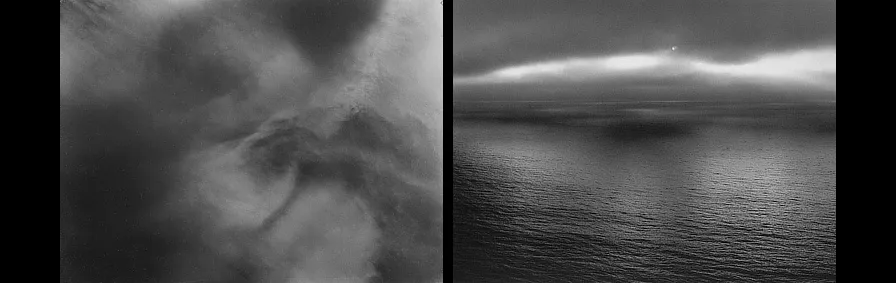
In the 19th century, the history of photography was marked by continuous changes in photochemical processes. Early photographic materials struggled to capture scenes with moving elements, as they were not very sensitive to light intensity. They also had difficulty rendering the shape of clouds, as whites and blues appeared in the same tone. Gustave Le Gray (1) was one of the pioneers in photographing the movement of sea waves with a cloudy sky, merging two separately captured images into one. Meanwhile, Charles Marville (2) experimented from his Paris studio with different materials to achieve greater definition in the shape of clouds, producing images of overcast skies above the city’s skyline.
In the 20th century, the history of photography became the story of the evolution of both the concept and the uniqueness of the photographic image. Alfred Stieglitz (3) introduced the concept of Equivalent to describe emotions through cloud photography. Expanding on this idea, Minor White (4) argued that Equivalents should take into account both the photographer’s and the viewer’s perspectives, as the inner gaze of the creator does not always align with the emotions experienced by the observer.
Keywords
References
Texts
- 1. Coe, B. (1977) Le premier siècle de la Photographie. Lausanne: Edita S.A. (Títol original: The Birth of Photography)
- 2. Los Grandes Fotografos (2018) [en línia]. Charles Marville (1813-1879) a: < http://losgrandesfotografos.blogspot.com/2018/01/charles-marville-1813-1879.html > (Data Consulta: 25 de febrer de 2024)
032 L’ evolució de las ciutats i la fotografia / Evolution of cities and photography
- 3. Newhall, B. (1983) Historia de la Fotografía: Desde sus orígenes hasta nuestros días. Barcelona: Editorial Gustavo Gili, S.A.(Títol original: The History of Photography from 1839 to the Present). P. 171.
“Stieglitz eligió un tema sobre el que no había control posible: el cielo y las nubes […] Llamó “equivalentes” a esas fotos, y las dispuso en series con otras fotos de contenido expresivo […] Las entendió como equivalentes a sus pensamientos, a sus ideas y aspiraciones, a sus desilusiones y temores. Vistas objetivamente, muchas de esas bellas fotos, con sus negros profundos, sus grises variados, sus blancos incandescentes, nos deleitan por la sola belleza de la forma”.
- 4. Fontcuberta , J. (1984). Estètica Fotogràfica: Selección de textos. Barcelona: Editorial Blume S.A. P. 213. Capítol XVIII: Minor White (1908-1976). B. Equivalencia: tendencia perpetua. (Publicado originariamente en P.S.A. Journal, n. 7, 1963)
“Los mecanismos por los cuales una fotografía funciona como un equivalente en la psique del espectador son los mecanismos familiares que los psicólogos llaman “proyección” y “empatía”. En el mundo del arte el fenómeno correspondiente es llamado “formas” y “figuras expresivas”. En el mundo de la fotografía la gran cantidad de espectadores permanece tan identificada con el objeto que se queda sin conocer las cualidades “expresivas” de las figuras y de los colores, o se queda temerosa de dejarse llevar y responder a los colores y figuras expresivas, es decir, al diseño de la experiencia pictórica. Afortunada o desafortunadamente, depende de cuál sea el caso, el espectador contemporáneo de fotografías casi siempre responde inconscientemente al diseño fijado en las fotografías ”.
Images
- Moma [en línia]. Alfred Stieglitz: Equivalent 1923 a: < https://www.moma.org/collection/works/44722 > (Data Consulta: 25 de febrer de 2024)
- White, M. (1978) Rites & Passages. New York: Aperture Foundation, Inc. P. 85.