074
Visual Interrelationships in Art History (Étienne Jules Marey, Marcel Duchamp & Gjon Mili)
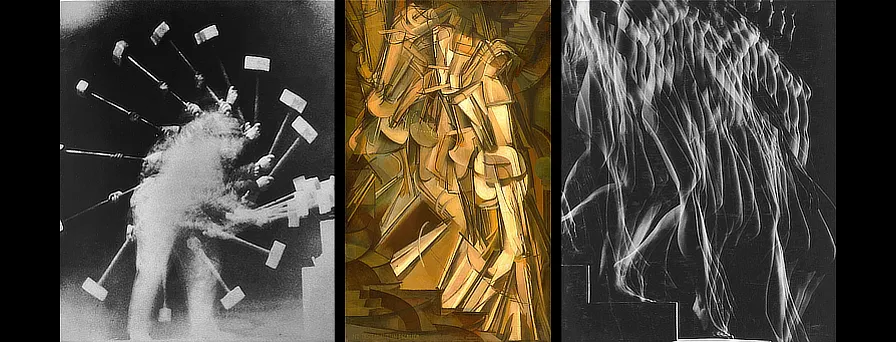
From a historical perspective, Otto Stelzer (1) and Aaron Sharf (2) speculated on the interrelations between photography and painting, and vice versa. Since the early days of photography, some realist painters have used it as a reference for their works. Moreover, the first aerial photographs and photographic research related to the dimension of time have influenced several abstract painters of the 20th century.
Étienne-Jules Marey (3), with his chronophotographs, used photography as a tool for studying movement. His images had a significant impact on science and technology, and his inventions are considered precursors to cinema. The artistic avant-garde recognised his visual contributions as a new way of perceiving reality. A notable example of this influence is Nu descendant un escalier, which Marcel Duchamp (4) painted in 1912, inspired by Marey’s studies.
In 1949, with advancements in lighting technology, Gjon Mili (5) paid tribute to Duchamp by creating a version of Nu descendant un escalier that utilised stroboscopic photography (6) with an electronic flash.
References
Texts
- 1. Stelzer, O. (1981) Arte y fotografía: Contactos, influencias y efectos. Barcelona: Editorial Gustavo Gili, S.A. (Títol original: Kunst und Photographie)
- 2. Scharf, A. (1994) Arte y fotografía. Madrid: Alianza Editorial, S.A. (Títol original: Art and Photography)
- 3. Stroebel, L; Zakia, R. (1993) Encyclopedia of Photography. Boston: Focal Press. P. 475.
“Marey, Étienne-Jules […] Invented methods and instruments for registering complicated and fleeting physiological actions; notably, a camera capable of making a series of images on a single plate, ºfor hearth action, and a photographic gun in 1882 for taking serial pictures of birds in flight. In 1887, introduced an early movie camera, the “chronophotograph […]”
- 4. Centre National de la Photographie (1983). Etienne-Jules Marey. Paris: Collection Photo Poche. Número 13. (Michel Frizot: Le Temps constitué: Récit chronophotographique avec arrêtes sur image. P.10)
“[…] Marcel Duchamp s’entretient avec un critique d’art et s’explique sur la genèse de son “Nu descendant un escalier”, de 1912, qui eut une retentissante influence sur l’art de ce siècle. “PC.— Dans le “Nu descendant un escalier” il n’ya pas une influence du cinéma? MD.— Bien sûr que si. C’est chose de Marey… PC.— La chronophotographie MD.— Oui, j’avais vu dans l’illustration d’un livre de Marey comment il indiquait les gens qui font de l’escrime, ou les chevaux au galop, avec un système de pointillé délimitant les différents mouvements. C’est ainsi qu’il expliquait l’idée du parallélisme élémentaire. Ça a l’air très prétentieux comme formule mais c’est amusant. C’est ce qui m’a donné l’idée de l’exécution du “Nu descendant un escalier” […] Pour Duchamp, la photographie instantanée, en s’affranchissant de la contrainte du temps, a créé une nouvelle sensibilité. L’image scientifique de Marey, non codifiée par des règles académiques, a semblé à l’artiste d’avant-garde un modèle de liberté qui lui tient un langage prometteur: le regard y perçoit un temps qui lui paraît réversible, qui n’est plus l’enveloppe de l’action mais l’object même de l’étude, le sujet de la dissection […]”
- 5. Life [en línia]. The photography of Gjon Mili. Disponible a: < https://www.life.com/photographer/gjon-mili/ > (Data Consulta: 6 d’abril de 2024)
- 6. Stroebel, L ; Zakia, R. (1993) Encyclopedia of Photography. Boston: Focal Press. P. 764-765.
“Strobe. An electronic flash unit that is capable of producing a rapid and continuous series of flashes of light, used in photography, for example, to obtain a series of displaced images in a single photography of a rapidly moving object, or of a stationary object by panning de camera. The frequency of firing is generally adjustable and on some units can be increased well beyond where it appears to be a continuous light […] Stroboscopic photography. The use of a pulsed electronic-flash light source to obtain multiple images of moving objects in photographs “.
Images
- Centre National de la Photographie (1983). Etienne-Jules Marey. Paris: Collection Photo Poche. Número 13. Làmina 21.
- Suàrez, A.; Vidal, M. (1989) El segle XX. Història Universal de l’Art. Volum IX. Barcelona: Editorial Planeta. (Capítol:L’exploració de Duchamp. P. 195.
- MA.Mutual Art [en línia]. Gjon Mili: Nu descendant l'escalier (hommage à Marcel Duchamp). Disponible a: < https://www.mutualart.com/Artwork/Nu-descendant-l-escalier--hommage-a-Marc/812E012365F18D70C291453348F1EA47 > (Data Consulta: 6 d’abril de 2024)