073
Lighting and Numerical Proportionality (Velázquez)
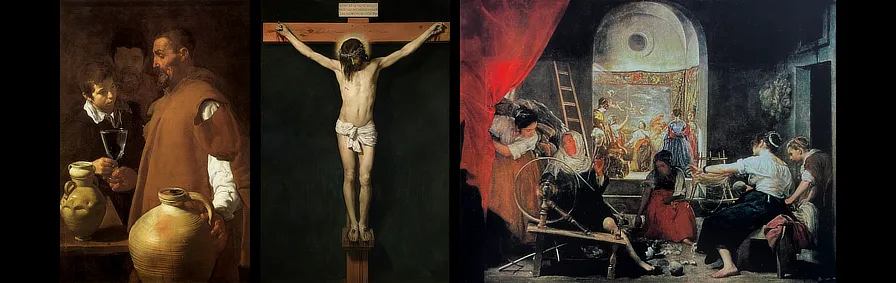
Velázquez (1) is one of the most significant realist painters in the history of art. His works serve as references in painting and photography due to his precise use of numerical proportionality in composition and his mastery of the distribution of light and shadow.
Maria José Jiménez, in the book Fotogra(fi)ando las matemáticas, analyses the compositional structure of the painting Las Hilanderas, which is founded on lines and rectangles exhibiting golden and Pythagorean proportions (2).
From a lighting perspective, the painting Cristo crucificado exemplifies the significance of light direction in portraying forms and volumes, skillfully distributing light and shadow throughout the image. Velázquez’s ability to perceive light is particularly evident in El aguador de Sevilla, where he showcases a profound understanding of specular and diffuse reflection (3) in the depiction of textures and the characteristics of alcarrazas (4). The glass cup held by the figures in the painting is defined by light contours against a dark background, a lighting technique known in photography as the dark field method (5).
References
Texts
- 1. Morales, J. L. (1989) Barroc i Rococó. Història Universal de l’Art. Volum VII. Barcelona: Editorial Planeta. (Capítol: Velázquez o la mirada de l’home modern. P. 238-255.
- 2. CARROGGIO (ed.) (2000) Fotogra(fi)ando las matemáticas. Barcelona: Carrogigio S.A. de Ediciones. P. 136-139 (Maria José Jiménez Roca. Escuela Técnica Superior de Arquitectura. Universidad de Granada: La belleza no es casual)
“La belleza no es casual. Sorprende ver la multiplicidad de cálculos y proporciones que hay en un cuadro de Velázquez y la belleza que a través de ello transmite. ¿Hay quizá una sensación de armonía universal en las proporciones que los matemáticos descubrieron, y los artistas lo aplicaron, que puede explicar que este concepto de belleza no casual? […] La organización del cuadro queda definida por unas líneas y rectángulos con proporciones pitagóricas y áureas. ¿Ingenio o técnica del pintor?”
- 3. Stroebel, L; Zakia, R. (1993) Encyclopedia of Photography. Boston: Focal Press. P. 441.
“Light can reflect from a subject as a diffuse reflection, direct reflect, or polarized reflection. Most surfaces produce some of each of these three types. The proportions vary with the subject, and it is the proportions of the reflections in the mix that make one surface look different from another”.
- 4. Real Academia Española [en línia]. Tesoro de los diccionarios históricos de la lengua española: alcarraza. Disponible a: <https://www.rae.es/tdhle/alcarraza > (Data Consulta: 8 d’abril de 2024)
“alcarraza, alcarraça, , arcarrasa. (Del ár. al-karrāz.) f. Vasija de arcilla porosa y poco cocida, que tiene la propiedad de dejar rezumarse cierta porción de agua, cuya evaporación enfría la mayor cantidad del mismo líquido que queda dentro”.
- 5. Stroebel, L ; Zakia, R. (1993) Encyclopedia of Photography. Boston: Focal Press. P. 441-443.
“Direct reflection strictly obeys the Law of Reflection, which states that the angle incidence equals the angle of reflectance. […] The surface of a photographic subject, however, is made up of an infinite number of points. A viewer looking at that surface sees each of these many different points as a slightly different angle. Taken together, these different angles make up the family of angles that cause direct reflection. […] Lighting glass, on the other hand, requires attention to the edges. Withoud good edge definition, transparent subjects tend to blend with de background. […] dark-field method… we now want the edge of the glass to be bright, there must be light at the far limits of the family of angles. The effective size of the background is the single most important […] The background must, of course, be large enough to fill the field of view. But if is it too large, it will extend into the family of angles that produce direct reflection on the edge of the glass. […] Ideally, the background should exactly fill the field of view the camera , no more and no less, Fortunately, this ideal is not strictly necessary in practice”.
Images
- Morales, J. L. (1989) Barroc i Rococó. Història Universal de l’Art. Volum VII. Barcelona: Editorial Planeta. P. 250.
- Museo del Prado [en línia]. Velázquez, Diego Rodríguez de silva y:Cristo crucificado. Disponible a: < https://www.museodelprado.es/coleccion/obra-de-arte/cristo-crucificado/72cbb57e-f622-4531-9b25-27ff0a9559d7 > (Data Consulta: 4 d’abril de 2024)
- CARROGGIO (ed.) (2000) Fotogra(fi)ando las matemáticas. Barcelona: Carrogigio S.A. de Ediciones. P. 137.