076
Evolution of the position of the point of view (Eugène Delacroix & Assassin’s Creed)
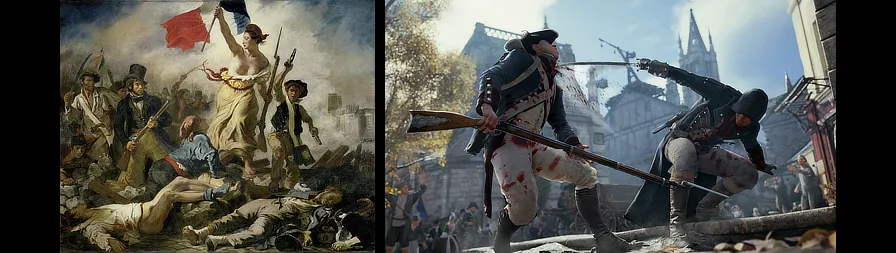
Pirenne (1), in his book Optica, Perspectiva, Vision, describes the importance of the position and distance between the point of view and the elements of a scene in defining the contours of subjects and objects in the composition of an image. He explains, using graphics and photographs taken with a pinhole camera (2), the differences between human and monocular vision in the distortion of spherical forms (3).
In the past, to avoid the deformation of figures (or the transformation of spheres into elliptical shapes) located at the edges of images, when composing perspective drawings or photographs, efforts were made to place the point of view far from the scene. Another option was to position elements with irregular contours close to the centre of the image.
With CGI, both technology and the adaptation of viewers to shape distortions have changed. Regarding sharpness, the virtual camera does not require the minimum focusing distance of an optical camera. For example, in Delacroix’s painting (4) and in an image from Assassin’s Creed (5), a classical perspective can be observed in contrast with the way video game players perceive images. Different representations of rifles can be compared, depending on whether the point of view is distant or close to the object.
Keywords
References
Texts
- 1. Pirenne, M.H. (1974). Optica, Perspectiva, Vision: en la pintura, perspectiva y fotografía.Buenos Aires: Editorial Victor Leru (Títol original: Optics, Paintings & Photography. 1970)
- 2. Stroebel, L.; Zakia, R. (1993) Encyclopedia of Photography. Boston: Focal Press. P. 81.
“Pinhole camera. A camera using a small hole made by a needle in a piece of thin opaque material, instead of a lens. The pinhole forms an image by allowing only a single narrow beam of light from each point on an object to reach the opposite surface. Light rays traveling through this pinhole continue in a straight line and form an inverted image on the opposite side of the box, where a piece of photosensitive emulsion is placed to record the image”.
- 3. Pirenne, M.H. (1974). Optica, Perspectiva, Vision: en la pintura, perspectiva y fotografía.Buenos Aires: Editorial Victor Leru (Títol original: Optics, Paintings &Photography. 1970). P. 143. “El contorno de una esfera siempre parece circular al ojo porque el cono tangente a la esfera con su vértice en el ojo siempre es un cono recto […] Cuando una figura está en exacta perspectiva central, la proyección de una esfera debe ser en la mayoría de los casos una elipse […]”
“El contorno de una esfera siempre parece circular al ojo porque el cono tangente a la esfera con su vértice en el ojo siempre es un cono recto […] Cuando una figura está en exacta perspectiva central, la proyección de una esfera debe ser en la mayoría de los casos una elipse […]”
- 4. Bornay, E. (1988) El segle XIX. Història Universal de l’Art. Volum VIII. Barcelona: Editorial Planeta. (Capítol: Delacroix. P. 237-249.
- 5. UBISOFT [en línia]. Assassin’s Creed. Disponible a: < https://www.ubisoft.com/es-es/game/assassins-creed> (Data Consulta: 9 d’abril de 2024)
Images
- Bornay, E. (1988) El segle XIX. Història Universal de l’Art. Volum VIII. Barcelona: Editorial Planeta. P. 246.
- Bornay, E. (1988) El segle XIX. Història Universal de l’Art. Volum VIII. Barcelona: Editorial Planeta. P. 246.
Video game frame.