077
photomontage and computer-generated model (Albert Speer, John Heartfield & The Man in the High Castle)
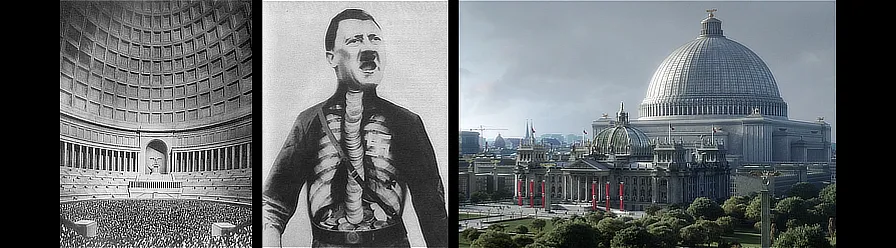
Since the beginnings of photography, the combination (1) of various negatives into a single image was used to overcome the technological limitations of the time. At the beginning of the 20th century, architectural projects began to incorporate the union of photographs and perspective drawings (2). Years later, the artistic avant-gardes used the fusion of images, known as photomontage (3), as a tool for fantasy.
By the end of the 20th century, the interrelation of CGI images with real cinematic images became frequent. The simplification of computer processes facilitated the integration of lighting for both real and virtual elements (4) in a photograph.
As an example, Albert Speer (5) created a photomontage with a model of the Volkshalle project, depicting Hitler’s image with the shadows of the lectern, the semi-dome above him, and the sculpture of the eagle in the background. From an opposing ideology, John Heartfield (6) designed the photomontage Adolf, der Übermensch: Schluckt Gol und redet Blech. More recently, Frank Spotnitz (7) in the TV series The Man in the High Castle included a CGI model of the Volkshalle (the Nazi project that was never built) within the image of a real space).
Keywords
References
Texts
- 1. Newhall, B. (1983) Historia de la Fotografía: Desde sus orígenes hasta nuestros días. Barcelona: Editorial Gustavo Gili, S.A. (Títol original: The History of Photography from 1839 to the Present). P. 74.
“Tirar copias múltiples, partiendo de diversos negativos, fue una tarea llevada al extremo por Oscar Gustave Rejlander, […] con una foto alegórica de 1857 titulada The Two Ways of Life (Las dos sendas de la vida). Concibió un vasto escenario en el que desarrollaba una alegoría”. Rejlander habría necesitado un enorme estudio y muchos modelos para hacer esa fotografía con un solo negativo. En lugar de ello, requirió los servicios de un grupo de cómicos ambulantes, y los fotografió por partes, a las escalas apropiadas para la distancia del espectador a la que aparecerían. En otros negativos registró modelos del escenario mismo. Hizo un total de treinta negativos, a los que superpuso de tal forma que se combinaran juntos, como un puzzle fotográfico”.
- 2. Riley, T. (2001) Mies in Berlin. New York: The Museum of Modern Art. (Capítol: Andres Lepik. Mies and Photomontage, 1910-38. P. 324)
“In incorporating his drawings in photomontages, Mies took up a form of architectural presentation initially used mainly in competition situations. Around 1900, Friedrich von Thiersch and other architects preparing competition submissions began the practice of mounting a drawing on a photograph of a building’s possible setting, making for greater realism and a more convincing simulation than the standard perspective drawings these images supplemented”.
- 3. Ades, D. (1977) Fotomontaje. Barcelona: Bosch, Casa Editorial, S.A. (Títol original: Photomontage.1976). P. 7.
“El término “fotomontaje”, sin embargo, no fue inventado hasta el final de la primera guerra mundial, cuando los dadaístas berlineses necesitaron un nombre para denominar la nueva técnica de introducir fotografías en sus obras. (El pintor futurista Carrà y el supramatista Malevich habían utilizado fotografías aisladas antes, pero no combinaciones de más de una fotografía o de fragmentos fotográficos, como hicieron los dadaístas.) Este nombre, pues, se divulgó dentro del contexto de un movimiento artístico (o antiartísco), y fue aceptado con rara unanimidad por los dadaístas berlineses, aunque más tarde discutieran sus exactos orígenes históricos dentro del mismo grupo”.
- 4. 050 El canvi en les grans produccions fotogràfiques / The change in large-scale production photography
- 5. BBC: Glancey, J. (2014) [en línia]. La Historia de NIANTIC: Reality made better”. Disponible a: < https://nianticlabs.com/about?hl=in > (Data Consulta: 15 d’abril de 2024)
- 6. Centre National de la Photographie (1987). Photomontages: Photographie experimentale de l’entre-deux-guerres. Paris: Collection Photo Poche. Número 31.
- 7. Frank Spotnitz [en línia]. The man in the High Castle. Disponible a: < https://www.frankspotnitz.com/work/mithc > (Data Consulta: 18 d’abril de 2024)
Images
- Counterlight’s Peculiars (2009) [en línia]. The Monster Dome. Disponible a: < http://counterlightsrantsandblather1.blogspot.com/2009/01/monster-dome.html> (Data consulta: 15 d’abril de 2024)
Photomontage with drawing and photography. Albert Speer. Volkshalle. 1936.
- Ades, D. (2002) Fotomontaje. Barcelona: Editorial Gustavo Gili, S.A. (Títol original: Photomontage. 1976). Il·lustració 53, P. 51.
Photomontage with drawing and photography. John Heartfied. Adolf, Der Übermensch: Schluckt Gol und redet Blech (AIZ). 1932.
- The man in the High Castle. [en línia]. Berlin. Disponible a: < https://the-man-in-the-high-castle.fandom.com/wiki/Berlin > (Data consulta: 15 d’abril de 2024)
Photomontage with cinema and CGI The Man in the High Castle. 2015-2019 (Creator: Frank Spotnitz).