038
Analogical Location of the Past (Institut Lumière & Julen Knez)
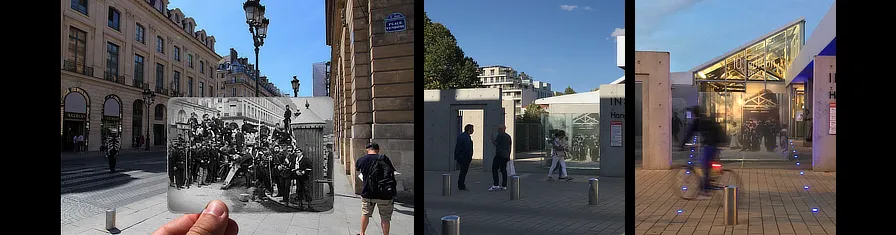
The utopia of Auguste and Louis Lumière to create a mass spectacle with moving images materialised at the end of the 19th century. What photography, limited to capturing static moments, had not achieved, cinema made possible by incorporating the dimension of time into a three-dimensional photographic representation (1). This breakthrough led to the definition of cinema as the Seventh Art (2).
A printed image commemorates the birth of cinema in front of the Institut Lumière in Lyon (3), where the remains of the old Lumière factory still stand. The photograph, printed on transparent material, is one of the frames from the 1895 film La Sortie de l’Usine Lumière. This photographic installation is an example of a “functional space ” (4), as defined by Gordon Cullen in his book Townscape.
The internet has enabled the exploration of different authors and artistic experiences that merge images from various historical periods. A notable example is Julien Knez (5), who photographs historical images while holding them in his hand at the exact location where they were initially taken. Through this method, he aligns the profiles of past buildings with present-day structures, offering an evocative perspective on events such as the Paris Commune of 1871 (6) or the May 1968 (7) protests.
Keywords
References
Texts
- 1. Villanueva, Ll. (1996). Perspectiva lineal: Su relación con la fotografía. Barcelona: Edicions UPC.
- 2. Gubern, R. (1971). Historia del cine.Vol. 1. Barcelona: Editorial Lumen. P. 28.
“[…] este formidable empuje de la civilización maquinista ha nacido a Lyon, precisamente, la maquina de “imprimir” la vida, como la llamará L’Herbier, y a partir de ella se creará un mundo fabulosos de mitos y de sueños”.
- 3. Institut Lumière [en línia]. Institut Lumière. Rue du Premier-Film, Lyon. Disponible a: < https://www.institut-lumiere.org/> (Data Consulta: 16 de desembre de 2023)
- 4. Cullen, G. (1981). El Paisaje Urbano. Tratado de estética urbanística. Barcelona: Editorial Lumen. (Títol original Townscape) P. 187.
“Espacio funcional. No hay procedimiento mejor para dar énfasis a un “acontecimiento” callejero como, por ejemplo, que el de proporcionarle su propia función en el mismo espacio que ocupa, con lo que gana en vitalidad y adquiere el tono centelleante que le da la conversación y la tensión”.
- 5. MY MODERN MET [en línia]. Artist Fuses Vintage Photographs with Present-Day Paris to Make History Come Alive. Disponible a: < https://mymodernmet.com/julien-knez-paris-then-and-now/ > (Data Consulta: 16 de desembre de 2023)
- 6. 037 Fotografia i ciències polítiques / Photography and political science
- 7. 039 Utopia i comunicació visual / Utopia and visual communication
Julien Knez. Paris. 1968-2016 (Rue Gay-Lussac i les barricades de les manifestacions del maig del 68) AVJET ROUTING [en línia]. Combined Old And New Photos Of Paris To Bring History To Life . Disponible a: < https://avjetnews.wordpress.com/2016/04/04/combined-old-and-new-photos-of-paris-to-bring-history-to-life/ > (Data Consulta: 15 d’abril de 2021)
Images
- AVJET ROUTING [en línia]. Combined Old And New Photos Of Paris To Bring History To Life. Disponible a: < https://avjetnews.wordpress.com/2016/04/04/combined-old-and-new-photos-of-paris-to-bring-history-to-life/ > (Data Consulta: 15 d’abril de 2021)
- Photography, day and night, with the photographic installation in front of the old Lumière factory. By day, the photograph is seen through the reflected light of the sun, while by night, it is seen through artificial backlight.