097
Visual taxonomies and photographic objectivity (Bernd and Hilla Becher & Axel Schmidt and Anna Defez)
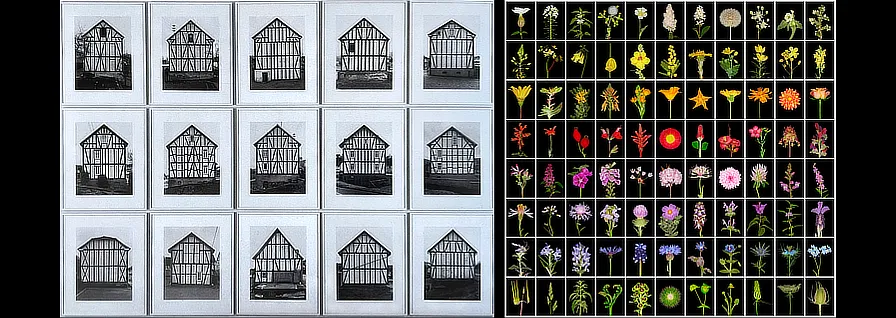
Photography has become a visual tool for preserving natural or artificial elements that disappear over time. In the history of visual communication, we can find authors such as Bernd & Hilla Becher (1), for whom visual taxonomies are a conceptual characteristic of their photographic work. The Bechers were systematic in their working process: they captured images of industrial architecture with a frontal perspective (almost always), using the same quality of light and displaying them in the form of a visual sequence, aligning the vertical and horizontal profiles of the components of the images in their photographic installations.
Inspired by Bernd & Hilla Becher (founders of the Düsseldorf School of Photography), Schmidt & Defez (2) create collections of flowers and natural elements, through an interdisciplinary collaboration between photography and design. They employ a meticulous photographic process, with multiple captures of images at different magnifications (3) and depths of field (4), and image processing assisted by intelligent software. The design of Schmidt & Defez's images, as well as their photographic sets, exemplify the use of technical processes (which anticipate the use of artificial intelligence) to serve the sensitivity and emotions of individuals.
References
Texts
- 1. Lemagny, J-C.; Rouillé, A.. (1988) Historia de la Fotografía. Barcelona: Ediciones Martínez Roca, S.A.. (Títol original: Histoire de la Photographie). P. 254.
“Bernhard y Hilla Becher empezaron en 1959 a reunir fotos sobre la arquitectura industrial que fuesen documentos utilizables. Sin efectos artísticos, eligen el enfoque más frontal y más neutro posible. Más tarde, se dan cuenta de que la foto es el único medio de preservar la belleza involuntaria de las construcciones destinadas a desaparecer y que pueden ordenarse conforme una tipología a la vez monótona y variada (los depósitos de agua, los altos hornos, etc.), como una clasificación efectuada por un naturalista. Ponen en serie imágenes que consideran cada vez menos como documentos sobre una arquitectura que como fotografías escultóricas o esculturas fotográficas (Anonyme Skulpturen, 1970)”.
- 2. A-D design [en línia]. COLORS: Ars Project. Disponible a: <https://annadefez.com/COLORS > (Data Consulta: 9 de juny 2024)
“The technique developed by Axel focuses on photo colour and a meticulous photographic process. Objects are removed (carefully) of their natural context and photographed against a black background, taking great care to avoid external influences. A consistent, neutral angle of view is chosen to ensure there are no shadows or reflections, emphasising pure colour and maximum sharpness. The project @colorsprojekt is inspired by Bernd & Hilla Becher, whose work reflects a similar spirit of systematic documentation. Bernd’s childhood industrial landscape, which he sought to preserve through photography, influenced Axel’s approach to capturing plants and mushrooms with the same intention — we document elements that might eventually fade over time. The final images are composed of up to 300 individual shots that are combined using specialized software, akin to a tomography process. This method allows us to achieve consistent sharpness across the entire image, creating a hyperrealistic effect that, due to its two-dimensional nature, becomes perceptible only in the photograph. In reality, plants are seen with pinpoint sharpness as the eye must focus multiple times to capture their full detail. In this context, we have introduced a unique concept of visual transitions. The photographs are presented on a high-resolution screen or monitor in vertical format, beginning as blurred images that gradually become sharper over a defined period. There is no depth of field, but the definition improves continuously, surprising the viewer with an image that seems to grow clearer as time passes. The intention is to inspire awe and reflection on the ever-changing world around us”.
- 3. Stroebel, L.; Zakia, R. (1993) Encyclopedia of Photography. Boston: Focal Press. P. 474.
“Magnification. (1) A scale of reproduction that is larger 1.0, that is, the image is larger than the object. (2) In optics, a scale of reproduction regardless of the value. Thus, a scale 1/5 is called magnification even though the image is only one-fifth the size of the object”.
- 4. 045 La metàfora visual de la nitidesa / The visual metaphor of sharpness
Images
- Hacking, J. (2013) Fotografía. Toda la Historia. Barcelona: Blume. (Títol original: Photography. The Whole Story). P. 402.
- Colors Projekt (@ColorsProjekt). 2023. A: X (abansTwiter) [en línia]. Data de publicació del post 10 Juny 2023. [Consulta: 9 Juny 2024]. Disponible a: https://x.com/ColorsProjekt/status/1667427105620017155/photo/1