041
Sharpness in Light and Darkness (Hiroshi Sugimoto, Yoshio Shiratori & Tadao Ando)
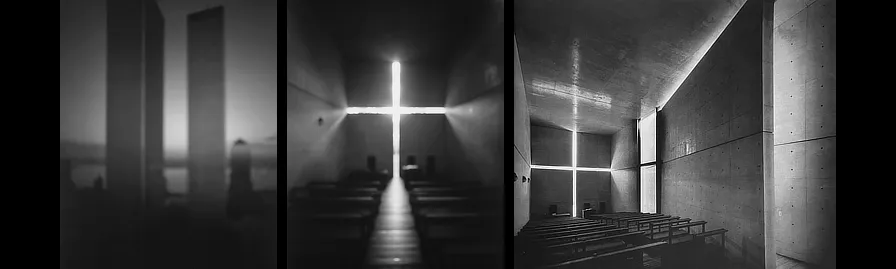
Light control and sharpness are vital aspects of visual communication in photography. Hiroshi Sugimoto (1) is an artist known for his minimalist, abstract, and symbolic style. In some pieces, he employs darkness (2) and blurred imagery (3). In the Theaters (4) series, he highlights the explosion of light amid shadows, while in Architecture, he focuses on key architectural elements, intentionally lacking sharpness.
Architect Tadao Ando (5) excels at using natural light in a geometric space. In 1989, he built the Church of Light in Osaka. From a Visual semiotic point of view, the light profile of the cross on the back wall of the chapel is a formal mixture of Western and Eastern symbolism. Yoshio Shiratori photographed it from the perspective of the architectural image, and Hiroshi Sugimoto from the perspective of the visual metaphor. Both photographs show the lack of dark adaptation (6).
Keywords
References
Texts
- 1. Sugimoto, H. [en línia]. HOME. Disponible a: < https://www.sugimotohiroshi.com > (Data Consulta: 29 de desembre de 2023)
- 2. Stoichita, V.I.. (2000). Breve Historia de la sombra. Madrid: Ediciones Siruela. (Títol original: A Short History of the Shadow ) P. 195.
“¡Qué difícil es comentar el Cuadrado negro de Malévich! Más difícil que cualquier otra iniciativa hermenéutica, ya que la pretensión de su creador era realizar un cuadro “alógico”, que no es lo mismo que una imagen desprovista de sentido, sino una imagen que se sitúa más allá del sentido. La única solución posible que le resta al intérprete de las formas culturales es un comentario indirecto y paradójico”.
- 3. Dondis, D. A. (1976). La sintaxis de la imagen: Introducción al alfabeto visual. Barcelona: Editorial Gustavo Gili, S.A. (Títol original: A Primer of Visual Literacy ). P. 145.
“La agudeza como técnica visual, está íntimamente ligada a la claridad del estado físico y a la claridad de expresión. Mediante el usos de contornos netos y de la precisión, el efecto final es nítido y fácil de interpretar. La difusividad es blanda, no aspira tanto a la precisión, pero crea más ambiente, más sentimiento y más calor”.
- 4. Sugimoto, H. [en línia]. ARTWORKS: Theaters. Disponible a: < https://www.sugimotohiroshi.com/new-page-7 > (Data Consulta: 29 de desembre de 2023)
- 5. EL CROQUIS (1990) Tadao Ando: Church of the Light. Madrid: El Croquis Editorial. Número 44, P. 98-106.
- 6. Stroebel L.; Zakia R. (1993) Encyclopedia of Photography.Third Edition. Boston, London: Focal Press. P. 183.
“The process by which a person’s visual perceptual system adjusts to a low level of illumination, producing an increase in sensitivity. For example, when first entering a darkroom, or a movie theater, everything appears darks and then gradually begins to lighten. In complete darkness, the maximum adjustment takes about forty minutes”.
Images
- Sugimoto, H. [en línia]. ARTWORKS: Architecutre. Disponible a: < https://www.sugimotohiroshi.com/new-page-5 > (Data Consulta: 29 de desembre de 2023)
- EL CROQUIS (1990) Tadao Ando: Church of the Light. Madrid: El Croquis Editorial. Número 44, P. 103.