042
The Decontextualisation of the Object and the Movement of the Subject (A. Siskind, A. Müller-Pohle & F. M. Neüsuss )
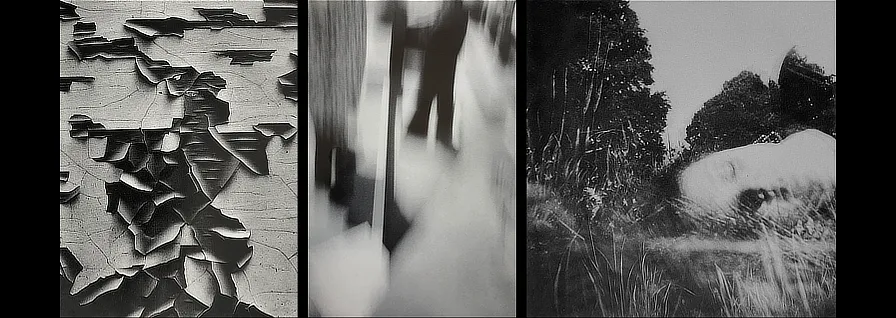
The development of photography in the 19th century had implications for the evolution of the concept and abstract aesthetic (1). In the 20th century, many photographic authors argued for a specific language of photography that went beyond painting and photography. The control of maximum sharpness, or the lack of it, was essential in the search for a new visual language. Some explored the decontextualisation (2) of the actual image, while others worked on the deconstruction (3) of photography from the technical processes of capture.
Weston and Siskind, for example, fragmented the real scenes with maximum sharpness. Through light and framing, Weston (4) transformed a pepper into a sculptural silhouette. Siskind composed abstractions out of pieces of walls, with images of great tonal contrast and sharply defined lines.
Neusüs and Müller-Pohle, for instance, blurred the edges of the photographed subjects. Neusüs produced “dreamy faces” by superimposing multiple images. Müller-Pohle converted each image point into a line by randomly shifting the camera during the photographic capture.
Keywords
References
Texts
- 1. Scharf, A. (1994) Arte y fotografía. Madrid: Alianza Editorial, S.A. (Títol original: Art and Photography ) P. 265.
“[…] en muchos círculos literarios y artísticos se expresaba un gran desdén por la plasmación mecánica y carente de imaginación de la vida cotidiana. Este rechazo a la vulgaridad del realismo fotográfico en el arte, como también en la literatura, contribuyó a la deliberada proscripción de la representación objetiva y a la vindicación de lo subjetivo, encomiándose, en cambio, lo artificial y lo antinatural. El toque humano, la intuición, y un concepto más abstracto de la realidad se consideraban ahora fundamentales en el arte, y llegó a ser esencial ir más allá de las limitaciones que imponían las lentes […]”.
- 2. Newhall, B. (1983) Fotografía. Historia de la Fotografía: Des de us orígenes hasta nuestros días. Barcelona: Gustavo Gili, S.A.. (Títol original: The History of Photography from 1839 to the Present)
- 3. Lemagny, J-C.; Rouillé, A. (1988) Historia de la Fotografía. Barcelona: Ediciones Martínez Roca, S.A.. (Títol original: Histoire de la Photographie)
- 4. Hacking, J. (2013) Fotografía. Toda la Historia. Barcelona: Blume. (Títol original: Photography. The Whole Story). P. 282.
Edward Weston, Pimiento nº30, 1930.
Images
- Center for Creative Photography, University of Arizona, Tucson (1991) Fotografia Americana del S. XX. Barcelona: Fundació “La Caixa”. P. 100.
- Photovision (1983) Fotografia Gestual. Gesture Photography: Andreas Müller-Pohle. Madrid: Photovision, S.A. Número 8, P. 29.
- Lemagny, J-C.; Rouillé, A.. (1988) Historia de la Fotografía. Barcelona: Ediciones Martínez Roca, S.A.. (Títol original: Histoire de la Photographie). P. 215.