029
Still Life by Women and Men (Fede Galizia & Toni Catany)
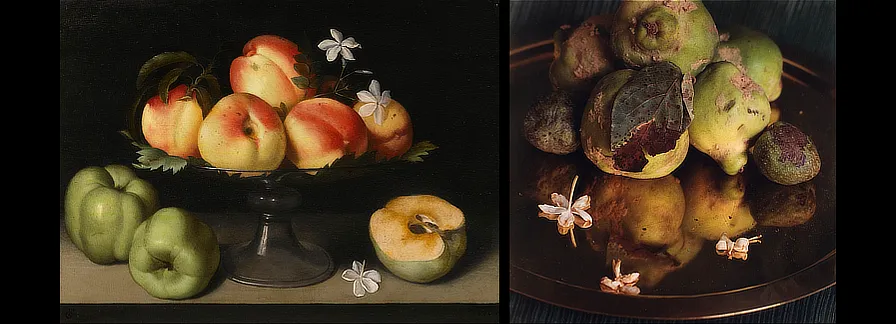
Photographic still lifes (1) draw inspiration from the pictorial still lifes characteristic of Realist aesthetics. The 17th-century (2) artists excelled in this genre, creating compositions filled with still and familiar elements, portrayed with remarkable precision and delicacy. While this genre is primarily utilised in advertising and industrial imagery, it also appears within the realm of artistic photography.
Still lifes are created calmly, distributing the static (non-living) elements between light and shade, carefully defining the objects’ outlines, shapes and textures. There are many examples of this genre in historical reflection. Personally, I have chosen Fede Galizia (3) and Toni Catany (4): she illustrated with detail and sensitivity the loss of shine and oxidation of fruit; he stood out for his mimesis of baroque aesthetics through photography.
References
Texts
- 1. Stroebel L.; Zakia R. (1993) Encyclopedia of Photography. Third Edition. Boston, London: Focal Press. P. 758.
“A still life is an arrangement of inanimate (or mostly inanimate) elements that express pictorial, narrative, or metaphorical content. Photographic still-life studies evolve from the tradition of still-life paintings that originated as early as the fifteenth century. The most basic challenge of the still-life photographer is to create a composition of objects that are defined by light. During the seventeenth century, the Dutch Masters produced exquisite still-life paintings. These opulent paintings contain lavish tableau arrangements of flowers, fruits, material treasures, and artifacts. The objects seem to be bathed in light that reveals texture, volume, space, and reality. Many photographers have followed the Dutch principles of the still-life, both as an art form and for commercial applications”.
- 2. Morales, J. L. (1989) Barroc i Rococó. Història Universal de l’Art. Volum Vii. Barcelona: Editorial Planeta. (Capítol La natura morta. P. 368.
“Són pintors que en el seu afany realista arriben a obtenir transcripcions de textures de porcellanes i ceràmiques, draps i aliments amb la més gran minuciositat i detallisme. La llum, el cromatisme, els efectes tonals, el dibuix, tot està en funció d’aquesta versió directa, d’aquesta “semblança” prodigiosa que sorprèn i captiva l’espectador. I aquest propòsit, que fa que el pintor sacrifiqui el seu ideari estètic, la seva tècnica particular, o fins i tot la pròpia originalitat al servei d’aquests motlles i fórmules , s’aguditza en la que s’anomena generació clàssica […] ”
- 3. Bodegones de cocina [en línia]. El bodegón en el Barroco: Fede Galizia y Giovanna Garzoni. Disponible a: < http://bodegonesdecocina.blogspot.com/2012/09/el-bodegon-en-el-barroco-fede-galizia-y.html > (Data Consulta: 4 d’abril de 2021)
- 4. Fundació Toni Catany [en línia]. Toni Catany. Disponible a: < https://fundaciotonicatany.cat/ > (Data Consulta: 4 d’abril de 2021)
Images
- NICHOLAS HALL [en línia]. Fede Galizia. Disponible a: < https://www.nicholashall.art/artist/fede-galizia/ > (Data Consulta: 4 d’abril de 2021)
Painting still life.
- Amics MNAC [en línia]. Natura morta,#157: Toni Catany. Disponible a: < http://www.amicsdelmnac.org/ca/actualitat/lobra-de-la-setmana-11 > (Data Consulta: 4 d’abril de 2021)
Photographic still life.