028
The Dimension of Time in Photography
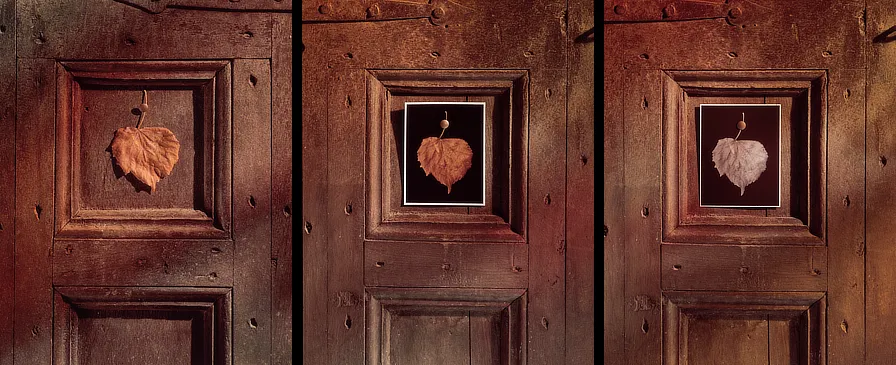
Visual communication examines both the interrelationship between form and content and the space-time dynamics. Time, regarded as a fourth dimension in three-dimensional space, has been explored within the framework of Relativity (1). It is speculated that since prehistoric (2) times, the images on cave walls were not merely static; some were designed to be viewed as part of a temporal (3) sequence. Walking by torchlight allowed viewers to see them as a visual narrative.
Light, serving as a metaphor for language, inspired me to undertake an experimental project on the various elements of visual communication in photography, encompassing the dimension of time and visual semiotics. In the visual sequence Tempus Fugit, one can observe the metaphor of a tree transforming into a door, with a leaf fallen from a branch. Only the memory of the leaf endures in the image, and over time, the colours of the photographic paper fade into a monochrome icon.
References
Texts
- 1. Ferrater, J. (1971). Diccionario de la Filosofía. Tomo II. Buenos Aires: Editorial Sudamericana. P. 792-793.
“ En la teoría de la relatividad generalizada, se procede a lo que se llama “fusión del tiempo con el espacio”: el tiempo es una cuarta coordenada o, mejor dicho, espacio y tiempo son coordenadas en un universo tetradimensional. Se ha dicho que ello representa una “especialización del tiempo”, pero debe tenerse en cuenta que la “fusión del tiempo con el espacio” no ha significado en dicha teoría que el tiempo sea concebido como si fuera espacio, en rigor, el universo tetradimensional es más bien un universo de tres más una dimensiones ”.
- 2. Saelind. (@saelind73). Lascaux: The Prehistory of Art. A: YouTube [en línia]. Data de publicació del post 11 Febrer 2023. [Consulta: 12 Novembre 2023]. Disponible a: https://www.youtube.com/watch?v=IhfXmueHrU “A 1995 Alain Jaubert film, La Sept Arte - Palette production”.
“Lascaux is the most beautiful and the most lavish of all the adorned prehistoric caves. But is there really such a thing as prehistoric "art"? Who were the painters of Lascaux? How to explain the striking stylistic unity of certain clusters, or the contradictions between similar figures that may be painted in different periods? The images themselves can only astonish and provoke questions. Lascaux furnihes evidence of refined knowledge and skill, which reflect a much more capable and complex prehistoric civilisation that we have yet imagined. The technology put to use in this film—computer graphics and special effects—facilitates a deeper investigation of the images. While comparing several hypotheses and expounding on the latest theories, the film also provides an encounter with a mythical, unfathomable site that continues to fascinate us”.
- 3. Arnheim, R. (1979) Arte y percepción visual. Madrid: Alianza Editorial. P. 472.
“La dinámica de una composición sólo será acertada si el “movimiento”de cada uno de los detalles encaja lógicamente dentro del movimiento de la totalidad. La obra de arte se organiza en torno a un tema dinámico dominante, del cual se irradia el movimiento a la extensión entera. Des de las arterias principales, el movimiento fluye hasta los capilares del menor detalle. Es preciso que el tema manifestado en el nivel más alto se extienda hasta el más bajo, y que los elementos pertenecientes a un mismo nivel marchen al unísono. La vista percibe el esquema acabado como totalidad y junto con las interrelaciones de sus partes […]”.
Images
- Photographic series on the passage of time, as part of the project Light as a metaphor for language.