031
The Analog Scenography
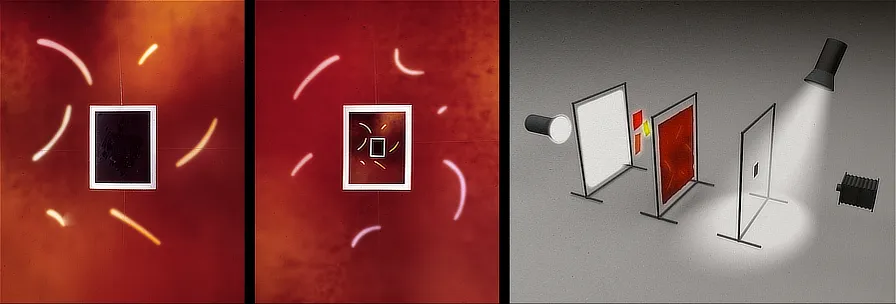
In the visual binomial The Black Polaroid, part of the project Light as a Metaphor for Language, the concept emerged from the idea of capturing a three-dimensional collage through photography. A scenography based on theatrical backdrops constructed a structure of supports and fishing lines. In front of a diffuse backlit light, some used and dirty packaging paper hung, along with cut-outs made with a knife and sheets of cellophane in various colours, cut into different shapes. Through the viewfinder of the view camera (1), and using a photometer with a probe in the viewfinder, one could control the perspective, the composition of the obstructions, the planes of sharpness (2), and the light and dark tones of the scene.
These types of montages became obsolete with the transition from analogue photography to digital imaging, thanks to digital processing with image layers, HDRI (3) intelligent software, and CGI photographic processes.
Keywords
References
Texts
- 1. Stroebel, L. (1993). View Camera Technique. Boston: Focal Press. P. 3.
“The name view camera has little significance with respect to the various methods of categorizing cameras, but the view camera is recognized as an important type of camera that has many uses…features that characterize them: 1. Ground-glass viewing for composing and focusing. 2. Lateral, vertical, and angular adjustment of the lens and back. 3. Accommodation of interchangeable lenses. 4. Flexible bellows connecting the front and back of the camera. 5. Large film size, usually in sheet form. 6. Designed to be used on a tripod”.
- 2. 047 Geometria òptica, frontalitat I fotografia / Optical geometry, frontality and photography
- 3. Bloch, Ch. (2007). The HDRI Handbook: High Dynamic Range Imaging for Photographers and CG Artists. Santa Barbara, CA: Rocky Nook Inc.
Images
- The first image is a Polaroid photograph that is totally underexposed. It is illuminated with a light source at 45°. Out of the reach of this light, a piece of wrapping paper with some incisions and a set of coloured translucent papers are placed at different distances from each other. A diffuse backlit light gives brightness and tonalities to the background behind the Polaroid.
- The second image features a Polaroid of the first. It uses the same lighting and staging. However, the background has been altered by replacing the wrapping paper with different cuts and the cellophane sheets with new colors.
- The third image is a CGI schematic of the set design used in the two previous images.