014
The External Gaze from the Inner Gaze (Diane Arbus)
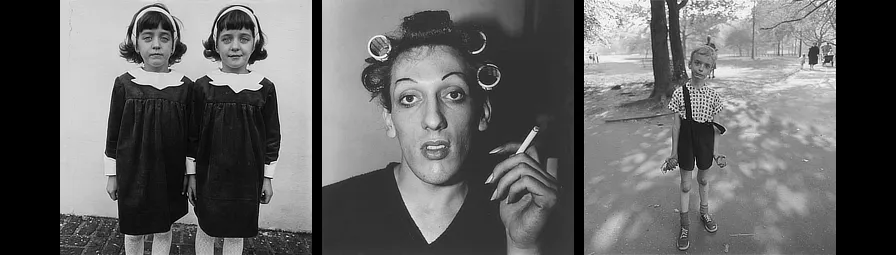
Petr Tausk (1) defines Diane Arbus's photographs as psychological portraits. From the perspective of visual narrative, her photographs convey a sense of visual "restlessness," both in terms of content (2) and the aesthetics of the images.
In the 1960s, Arbus travelled around New York to choose the people she wished to portray. Her photographs reveal her inner gaze (in search of bizarre individuals and taboo subjects) and her external gaze (in pursuit of the expressions of people, employing a photographic composition that hints at symmetry).
Susan Sontag (3) explains that the bitterness conveyed by her images reflects her state of mind, which ultimately led her to take her own life in 1971, at the age of 48.
Keywords
References
Texts
- 1. Tausk (1978). Historia de la Fotografía en el siglo XX: De la fotografía artística al periodismo gráfico. Barcelona: Editorial Gustavo Gili, S.A. ( Títol original: Die Geschichite der Fotografie im 20. Jahrhundert. Von der Kunstfotografie bis zum Bildjournalismus)
- 2. Sontag, S. (1981). Sobre la Fotografia. Barcelona: Edhasa. ( Títol original: On Photography ). P. 43-44.
“El aspecto más asombroso de la obra de Arbus es que parece haberse enrolado en una de las empresas más vigorosas de la fotografía artística —concentrándose en víctimas, en infortunados—pero sin el propósito compasivo que presuntamente debería perseguir dicho proyecto. Su obra muestra gentes patéticas, dignas de lástima, y también repulsivas, pero no suscita ningún sentimiento de compasión”.
- 3. Sontag, S. (1981). Sobre la Fotografia. Barcelona: Edhasa. ( Títol original: On Photography ). P. 49-50.
“Estoy segura de que no hay límites”, escribió Diane Arbus. “Dios sabe que cuando las tropas empiezan a avanzar sobre ti te aproximas de veras a esa sensación de pánico que por cierto puede liquidarte”. Retrospectivamente, las palabras de Arbus describen una especie de muerte en combate: tras haber trasgredido ciertos límites cayó en una emboscada psíquica, víctima de su propio candor y curiosidad. En la vieja saga del artista, cualquier persona que tenga la temeridad de pasar una temporada en el infierno se arriesga a no regresar con vida o a volver psíquicamente dañado”.
Images
- Public Delivery [en línia]. Diane Arbus’ iconic Twins photo - What is the story behind it?. Disponible a: < https://publicdelivery.org/diane-arbus-twins/ > (Data Consulta: 19 de març de 2021)
- Princeton University. Art Museum [en línia]. A Young Man in Curlers at Home on West 20th Street, New York City, 1966. Disponible a: < https://artmuseum.princeton.edu/collections/objects/13412?qt-object_data=3 > (Data Consulta: 19 de març de 2021)
- El País [en línia]. Diane Arbus, directa al corazón. Disponible a: < https://elviajero.elpais.com/elviajero/2012/07/04/actualidad/1341393694_683373.html > (Data Consulta: 19 de març de 2021)