027
The Loop in the Photographic Sequence (Duane Michals)
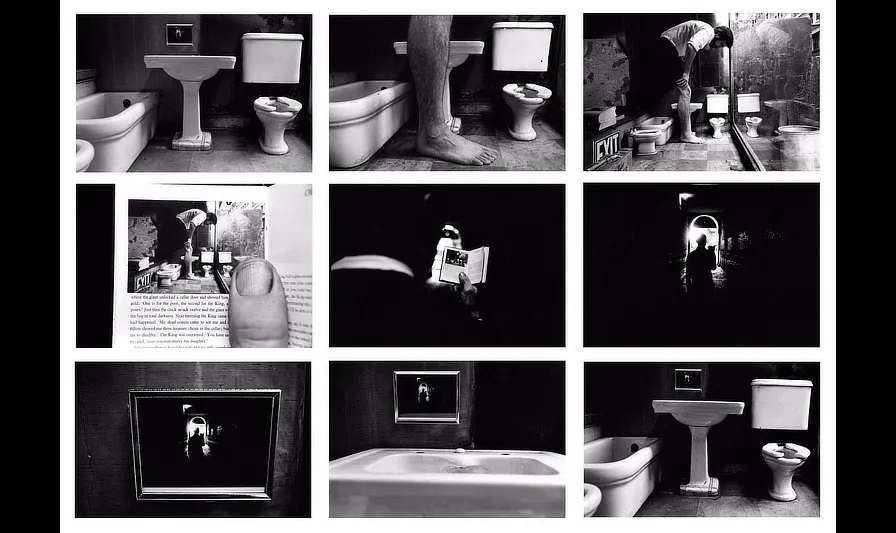
Duane Michals (1) distinguished himself with his distinct aesthetic and portrayal of concepts through photography. He believed that the essence of a photograph lies not in its visual elements but in its philosophical implications (2). Since 1966, he employed visual sequences and occasionally included handwritten texts alongside his images to articulate his philosophical and metaphysical ideas (3).
The Things Are Queer series, created in 1973, stands out as one of the finest photographic sequences in visual communication history. It presents a series of peculiar spaces through a continuous photographic narrative, offering viewers an infinite array of images. This series aligns with Kierkegaard's philosophy (4), particularly his concept of repetition, which suggests a barrier to progress stemming from the absurd.
Keywords
References
Texts
- 1. CLAVOARDIENDO (2017) [en línia]. Duane Michals, el hombre que fotografió su pensamiento. Disponible a: < https://clavoardiendo-magazine.com/mundofoto/panorama/duane-michals-hombre-fotografio-pensamiento/ > (Data Consulta: 8 de novembre de 2023)
- 2. Centre National de la Photographie (1982). Duane Michals. Paris: Collection Photo Poche. Número 12. P. 4.
“[…]Duane Michals. il l’a répété cent fois: “L’important n’est pas l’apparence des choses, mais leur nature philosophique”. Si pourtant leur nature philosophique allait être leur apparence? L’artiste ni le penseur, en Michals, ne peuvent échapper tout à fait à ce terrible soupçon ” (Renaud Camus: L’ombre d’un double)
- 3. Centre National de la Photographie (1982). Duane Michals. Paris: Collection Photo Poche. Número 12. P. 3.
“Les préoccupations philosophiques et métaphysiques dont il fait état avec insistance, à propos de son art, sont discrètement colorées d’une religiosité plus ou moins refoulée, clairement manifestée par le vocabulaire des titres: âme, ciel, Paradis, esprit, fils prodigue, Jésus-Christ, énorme faute […] ” (Renaud Camus: L’ombre d’un double)
- 4. Ferrater, J. (1971). Diccionario de la Filosofía. Tomo II. Buenos Aires: Editorial Sudamericana. P. 565.
“ …Pues mientras la repetición en lo natural —y aun la reminiscencia platónica en lo espiritual — se vuelca hacia el pasado, la repetición kierkergaardiana se encamina hacia al futuro. La repetición es engendrada, así, por el absurdo, y por eso es un elemento esencial al cristianismo ”.
Images
- Hacking, J. (2013) Fotografía. Toda la Historia. Barcelona: Blume. (Títol original: Photography. The Whole Story). P. 340.