034
The Invisible Cities
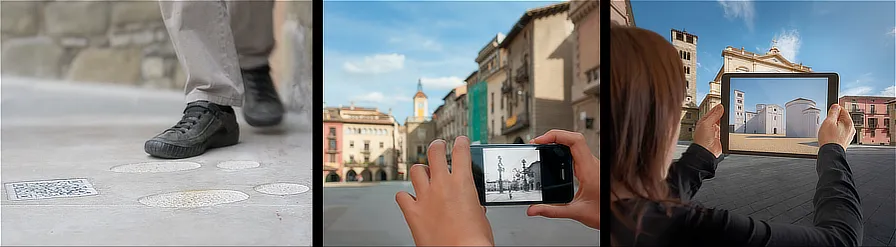
The Invisible Cities project by FCAVV (1) was an evolution of the Walls with Photographs (2) projects, incorporating the city imagery visions of Italo Calvino (3). In Invisible Cities, the writer describes how, when walking through a historic town, one can sense and imagine the past experiences lived in those streets.
To carry out the project, experiments were conducted with technologies (4) related to Augmented Reality, allowing historical photographs to be visualized from the exact locations where they were originally taken. The photographer’s footprints were marked on the pavement, and through image fusion techniques, the real view was combined with the image displayed on a mobile platform screen. This alignment made it possible to match the visual obstructions (5) in the historical photographs with the current buildings.
The incorporation of photographic CGI introduced new methodologies for understanding and disseminating history, as well as virtually reconstructing architectural structures that no longer exist.
References
Texts
- 1. La Farinera, Centre d’Arts Visuals de Vic [en línia]. Ciutats Invisibles. Disponible a: < https://www.lafarinera.cat/index.php?option=com_content&view=article&id=58&Itemid=254&lang=ca > (Data Consulta: 20 de novembre de 2023)
- 2. 033 La fotografia com escenografia de la ciutat / Photography as the scenography of the city
- 3. Calvino, I. (2011) Las ciudades invisibles. Madrid: Ediciones Siruela. (Títol original: Le città invisibili)
- 4. Carbonell , E. (2007) El naixement d’una nova consciència. Badalona: Ara Llibres, S.L. P. 133.
“Les noves tecnologies al servei de l’educació poden convertir el món urbà en una xarxa educadora i transformadora en línia”.
- 5. 032 L’ evolució de las ciutats i la fotografia / Evolution of cities and photography
Images
- The first image shows one of the marks on the pavement, highlighting the viewpoint from which a historic photograph of the project was taken.
- The second image illustrates the relationship between the real image and the old image from a mobile phone.
- The third image depicts the old medieval cathedral of Vic, positioned in front of the current cathedral.