066
Science and Technology in Visual Abstraction (Man Ray, Pierre Cordier & Jared Tarbell)
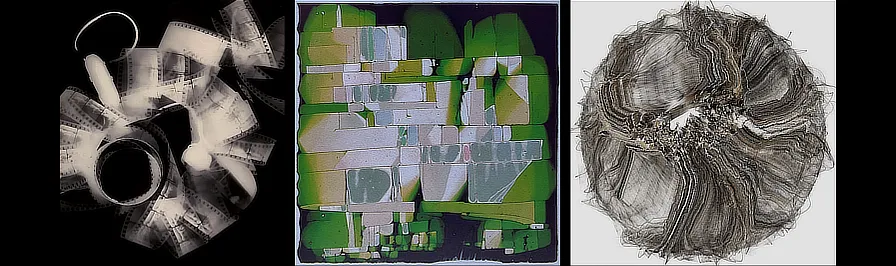
Photography emerged from the convergence of several factors: the camera obscura, optics, physics, chemistry, and social changes. The photograms (1)featuring leaf and plant silhouettes by Wedgwood and Fox Talbot are among the earliest preserved images on photosensitive material (2). These camera-less photographs have been known by various names, depending on the author and the period in photographic history.
At the beginning of the 20th century, photograms were rediscovered and revalued as part of the abstract aesthetic movement in avant-garde art (3). Pioneers such as Moholy-Nagy and Man Ray challenged traditional photography, pushing its boundaries. A striking example is Man Ray’s photogram of a film reel.
This aesthetic has continued to evolve with scientific and technological advancements. Pierre Cordier (4) developed chemigrams—visually stunning images created through chemical processes. Generative art pioneers like Jared Tarbell (5) produce abstract CGI images through programming and mathematics. The rise of AI-generated art represents yet another transformation in visual communication, further blurring the lines between art, science, and photography.
References
Texts
- 1. Stroebel L.; Zakia R. (1993) Encyclopedia of Photography.Third Edition. Boston, London: Focal Press. P. 559.
“PHOTOGRAM. An image produced without camera or optics by interposing a transparent, translucent, or opaque object in a beam of light falling on photographic paper or other sensitized material. Opaque objects in full contact with the sensitized material will block all light and no exposure will result. Transparent objects will permit exposure as a function of their base densities. Objects that are shiny, translucent, or not in full contact can produce a complex series of reflections, shadows, and patterns that are capable of eliciting surprise”.
- 2. Coe, B. (1977) Le premier siècle de la Photographie. Lausanne: Edita S.A. (Títol original: The Birth of Photography)
- 3. Ray, M. (1980) Fotografías: París 1920-1934. Barcelona: Editorial Gustavo Gili S.A. (Títol original: The Age of Light, Nueva York, 1934). (Andreas Haus: Introducción. P. 1)
“En Estados la aptitud de la fotografía para la visión abstracta y alienante había sido discutida antes que en Europa. Ya en 1916, Alvin Langdon Coburn , que al igual que Man Ray estaba en contacto con el círculo de Stieglitz, escribía: “La fotografía debe alienarse junto con todas las demás artes, y por medio de sus infinitas posibilidades debe lograr que los objetos resulten más extraños y fantásticos que los sueños fantásticos. Deseo que la fotografía mantenga una relación viva con el espíritu de progreso. Sino fuera posible que todas las artes sean modernas con todo lo nuevo, sería preferible quemar nuestras cajas negras”.
- 4. Cordier, P. [en línia]. Le chimigramme / the chimigram. Disponible a: < http://www.pierrecordier.com/ > (Data Consulta: 9 de març de 2024)
- 5. Artnome: Bailey, J. (2020) [en línia]. Interview Whit Generative Artist Jared Tarbell. Disponible a: < https://www.artnome.com/news/2020/8/24/interview-with-generative-artist-jared-tarbell> (Data Consulta: 9 de març de 2024)
Images
- Ray, M. (1980) Fotografías: París 1920-1934. Barcelona: Editorial Gustavo Gili S.A. (Títol original: The Age of Light, Nueva York, 1934). P. 89.
- Lemagny, J-C.; Rouillé, A.. (1988) Historia de la Fotografía. Barcelona: Ediciones Martínez Roca, S.A.. (Títol original: Histoire de la Photographie). P. 254.
- Artnome. Bailey, J. (2020) [en línia]. Interview With Generative Artist Jared Tarbell. Disponible a: < https://www.artnome.com/news/2020/8/24/interview-with-generative-artist-jared-tarbell > (Data Consulta: 9 de març de 2024)