067
The Analogue Photographic Mosaic
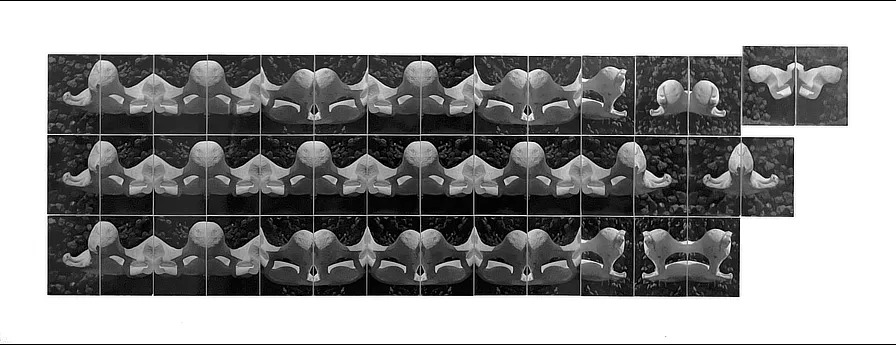
In the 1980s, under the influence of structuralist philosophy concepts (1), experiments were conducted in creating photographic mosaics with an abstract aesthetic. Sets of images were generated through the deconstruction and reconstruction of objects, combining continuous and discontinuous structures. These images were often black and white, with light elements superimposed on dark backgrounds. The objects depicted were typically cloud formations with blurred outlines or sculptures with sharp contours. Photographs were captured from different viewpoints to explore changes in contours and the dimension of time.
The creation process (2) in analogue photography was extremely slow. All images had to maintain tonal consistency, and the underexposure or overexposure (2) of particular areas had to be meticulously controlled to ensure uniformity across identical photographs. At that time, the first personal computers with basic image-processing capabilities began to appear. It was only a matter of time before the structuring of visual mosaics became more straightforward and faster, thanks to digital tools.
References
Texts
- 1. Ferrater, J. (1971). Diccionario de la Filosofía. Tomo II. Buenos Aires: Editorial Sudamericana. P. 566.
“El significado del vocablo “estructura” está relacionado con los significados de los términos “forma”, “configuración”, “trama”, “complexo”, “conexión” (o “interconexión”), “enrejado” y otros similares. “Estructura” designa un conjunto de elementos solidarios entre sí, o cuyas partes son funciones unas de otras. Los componentes de una estructura se hallan interrelacionados; cada componente está relacionado con los demás y con la totalidad. Se dice por ello que una estructura está compuesta de miembros más bien que de partes, y que es un todo […]”.
- 2. 068 Els contactes i la poesia visual / Contacts and visual poetry
- 3. Adams, A. (1994) The Print. New York: Little, Brown & Company. P. 104.
“The technique for dodging or burning involves holding the device under the light source with continuous movement for the required part of the total exposure (dodging), or for an additional exposure time (burning). If the card is allowed to remain stationary, even for part of the exposure, an obvious edge is likely to be visible in the print. I suggest a continual but gentle movement of the device; there is no need for frantic action”.
Images
- Example of a photographic structure with different images. The object was part of a sculpture by Enric Sala made from a light-coloured stone. A coal warehouse was used as the background for the image. All images are of the same sculpture, decontextualised and reconstructed with a new formal structure. The same image was repeated periodically and in some of the repetitions the negative was inverted.
Toni Bover. Photo mosaic. 80s.