071
The Rembrandt Light in Photography (Rembrandt Harmenzoon van Rijn & Gaspard-Félix Tournachon)
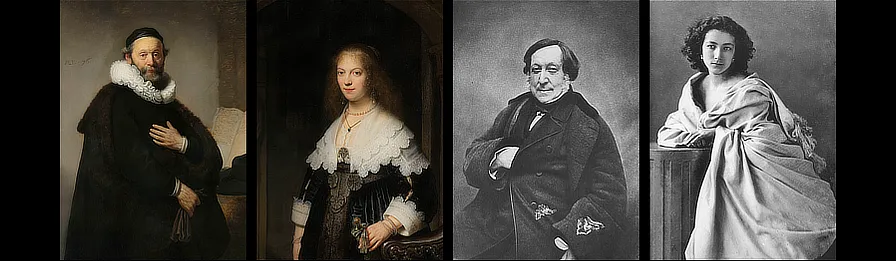
The earliest photography studios utilised natural light and were located at the tops of buildings. They boasted large glass windows in the ceiling and on one side, specifically in the north-facing section of the studio (1). This orientation provided consistent lighting throughout the day by preventing direct sunlight from disturbing the interior space. However, the lack of direct sunlight diminished light intensity, requiring subjects to remain still for several seconds to avoid blurred images.
Early portraits emulated a realistic pictorial aesthetic, with Rembrandt (2) as a pivotal reference owing to his mastery of light and shadow, both in portraying subjects and in the backgrounds of his works.
Early photographers controlled these contrasts by adjusting the subject’s position in relation to the camera and by strategically placing curtains over the studio’s glass windows. A notable portrait photographer from this period was Gaspard-Félix Tournachon, better known as Nadar (3). The technique known as "Rembrandt lighting" (4) would become a defining technique in portrait photography and an integral part of the photographic lexicon throughout history.
Keywords
References
Texts
- 1. Petzold, P. (1973) La iluminación en el retrato. Barcelona: Ediciones Omega, S.A. (Títol original: Light on People). P. 142.
“El estudio acristalado proporcionaba protección contra el tiempo y un cierto control de la iluminación. Todos los escritos recomendaban aberturas hacia el NO desde el NE al N, con una vista continua del cenit al horizonte para que el ángulo de la luz y su intensidad pudiesen modificarse con la posición del sujeto y por las persianas que cubrían el acristalado. Se evitaban los estudios con fachada al S por la excesiva intensidad de la luz y su variabilidad. Para las variaciones debidas al paso de las nubes ante el sol las persianas resultarían ineficaces y el sol directo sobre el sujeto daría una iluminación dura e incontrolable”.
- 2. Morales, J. L. (1989) Barroc i Rococó. Història Universal de l’Art. Volum VII. Barcelona: Editorial Planeta. (Capítol: Rembrandt. P. 352-361.
“[…] el clarobscurisme de Rembrandt anà adquirint les seves característiques especials a base de contorns en els quals la llum es dilueix en tamisos de subtilíssimes lluïssors, atmosferes fantàstiques i clarors misterioses que recullen les seves figures minucioses, d’execució exquisida”.
- 3. Carone-Chenz, W. (1980). Le Portrait. Paris: Editions Denoël-Filipacchi. (Le premier grand portraitiste français: Nadar. P. 18-19)
- 4. Petzold, P. (1973) La iluminación en el retrato. Barcelona: Ediciones Omega, S.A. (Títol original: Light on People) (La iluminación a lo Rembrandt P. 140)
Images
- Rijksmuseum [en línia]. Johannes Wtenbogaert, Rembrandt van Rijn, 1633. Disponible a: < https://www.rijksmuseum.nl/nl/rijksstudio/historische-personen/johannes-wtenbogaert/objecten#/SK-A-4885,1 > (Data Consulta: 28 de març de 2024)
- Rijksmuseum [en línia]. Portrait of a Woman, Possibly Maria Trip, Rembrandt van Rijn, 1639. Disponible a: < https://www.rijksmuseum.nl/en/my/collections/56952--meg-den-hartog/rembrandt/objecten#/SK-C-597,2 > (Data Consulta: 28 de març de 2024)
- Centre National de la Photographie (1982). Nadar. Paris: Collection Photo Poche. Número 1. Figura 35.
- Centre National de la Photographie (1982). Nadar. Paris: Collection Photo Poche. Número 1. Figura 115.