072
The Quality of the Light (Johannes Vermeer & Caravaggio)
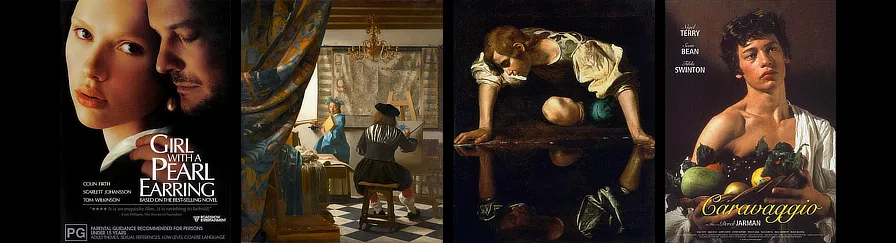
The control of light quality is an essential element in photographic creation, both for still images and motion pictures. The practice of lighting involves mastering the observation and understanding of light's physics. Art history describes the treatment of light and shadow in realist painting as one of the key components of visual communication.
Generally speaking, there is a significant visual difference between specular light and diffuse light (1), as well as between direct sunlight and the light on a cloudy day. Caravaggio’s (2) paintings exemplify hard light, while Vermeer’s (4) are characterised by soft light. Caravaggio created a strong contrast between light and shadow, while Vermeer depicted a smooth transition between different luminosities in the bright and dark areas of his paintings.
Filmography about these artists visually illustrates their unique understanding of light. The film Caravaggio (4) shows how the painter illuminated his scenes using mirrors to direct sunlight into the room. Meanwhile, Girl with a Pearl Earring (5) explores Vermeer’s perception of light and shadow through the camera obscura. The novel (6), upon which the film is based, even describes how the cleanliness of the windows can alter the quality of light.
Keywords
References
Texts
- 1. Stroebel, L ; Zakia, R. (1993) Encyclopedia of Photography. Boston: Focal Press. P. 439.
“[…] important characteristic of a single source is its degree of diffusion. A light source is said to be highly diffused if its rays strike the subject from many different angles. Conversely, light rays from an undiffused source all strike the subject from approximately the same angle. If there is only one light source, the degree of diffusion determines the range of tones at the boundary between the highlight and the shadow. A completely undiffused light, a point source, produces only bright highlight and deep shadow. Rays from a highly diffused source illuminate the subject from directions other than the principle one, partly filling some of the shadow area to produce a more gradual transition of tones”.
- 2. Milicua, J. (1990) Renaixement (II) i Manierisme. Història Universal de l’Art. Volum VI. Barcelona: Editorial Planeta. (Capítol: Al llindar del Barroc: Caravaggio. P. 382-395.
- 3. Morales, J. L. (1989) Barroc i Rococó. Història Universal de l’Art. Volum VII. Barcelona: Editorial Planeta. (Capítol: Vermeer i l’escola de Delft. P. 362-365.
- 4. filmaffinaty [en línia]. Caravaggio. 1993. Disponible a: < https://www.filmaffinity.com/es/film757283.html > (Data Consulta: 2 d’abril de 2024)
- 5. filmaffinaty [en línia]. La joven de la perla (Girl with a Pearl Earring. 2003). Disponible a: < https://www.filmaffinity.com/es/film759947.html > (Data Consulta: 2 d’abril de 2024)
- 6. Chevalier, T. (2012) La noia de la perla. Barcelona: RBA Llibres, S.A. (Títol original: Girl with a Pearl Earring. 1999). P. 54-64.
“[…] Els vidres eren bruts i caldria fregar-los amb aigua calenta, però no sabia si ell els volia nets. Ho hauria de preguntar a Catharina. […] Mentre Catharina obria la porta de l’estudi, el segon matí, li vaig preguntar si havia de netejar les finestres. —Per què no?— va respondre amb brusquedat —. Potser canviaria el quadre, si les netegés: Ho entén? No ho entenia […]”
Images
- filmaffinaty [en línia]. La joven de la perla (Girl with a Pearl Earring. 2003). Disponible a: < https://www.filmaffinity.com/es/film759947.html > (Data Consulta: 2 d’abril de 2024)
Cover of the film.
- Kunsthistorisches Museum [en línia]. El arte de la pintura: Rozando la perfección. Disponible a: < https://historia-arte.com/obras/el-arte-de-la-pintura > (Data Consulta: 2 d’abril de 2024)
- Galería Nacional del Arte Antiguo [en línia]. Narciso: Retrato de Narciso, el vanidoso joven enamorado de sí mismo que muere ahogado, pero es convertido en una flor. Disponible a: < https://historia-arte.com/obras/narciso > (Data Consulta: 2 d’abril de 2024)
- filmaffinaty [en línia]. Caravaggio. 1993. Disponible a: < https://www.filmaffinity.com/es/film757283.html > (Data Consulta: 2 d’abril de 2024).
Cover of the film.