081
Lines of Fire and Light Stains
Ansel Adams and Minor White (1) described the concept of previsualisation (2) as a process of mentally imagining, before capturing a photograph, the contrast between the light and dark areas of the final image. In colour photography, additionally, it was necessary to anticipate the relationship between the colour temperature (3) of the light source and the characteristics of the film. With electronic imaging, the concept of previsualisation evolved towards instant viewing, thanks to the ability to immediately review the photographic capture on a screen built into the camera.
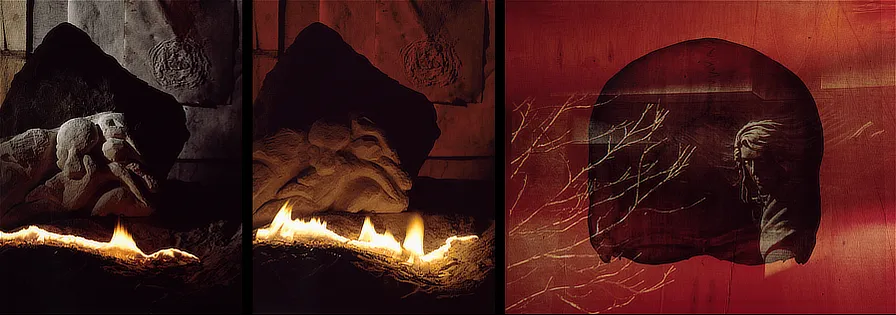
In Light as a Metaphor for Language, I experimented with photographic previsualisation, studying both the colour of the final image and the dimension of time in photographic capture. For instance, I merged the light from an electronic flash (4) with firelight. After the flash’s burst, in the darkness, I directed a point of light along a strip of paper to create a line of fire (5) in the final photograph.
On another occasion, I designed an image fusion by combining flash lighting with the projection of a slide. I illuminated a painting with an electronic flash, placing red and yellow cellophane pieces in front of the light source to create coloured stains on the surface. After the flash’s illumination, the projection of a photograph continued to light up the painting for some time, keeping the image visible beyond the initial moment.
References
Texts
- 1. 046 La màxima nitidesa en la fotografia analògica / Maximum sharpness in analogue photography
- 2. White, M. (1967) Zone System Manual: How to previsualize your pictures. New York: Morgan & Morgan. P. 13.
“Previsualization stands for the act of looking at a scene with the physical eye and seeing in the mind’s eye how a medium can render the subject. Previsualization refers to the learnable power to look at a scene, person, place or situation and “see” at the same time on the back of the eyelids, or “sense” deep in the mind or body, the various ways photography can render the subject. Then out of all the potential renderings select one to photograph. Such selection make up a large share of the photographer’s creativity”.
- 3. Stroebel, L.; Zakia, R. (1993) Encyclopedia of Photography. Boston: Focal Press. P. 154-155.
“A light sources emit electromagnetic radiation, some of which is in the visible region between 400 and 700nm in wavelength. The amount of the radiation emitted at each wavelength, and the total amount of radiation emitted, varies from source to source. The most exact way to described the radiation emitted is with a spectral energy distribution diagram, which specifies the amount of energy emitted at each wavelength. […] Color temperature is particularly important in color photography because color films are designed to give optimal color rendition only when exposed using light of a specified color temperature”.
- 4. Stroebel, L.; Zakia, R. (1993) Encyclopedia of Photography. Boston: Focal Press. P. 314.
“Flash, electronic. A lighting system that produces a brief, intense burst of light by electrical discharge through an atmosphere of xenon or other inert gas in a sealed transparent or translucent called a flashtube, which can be used repeatedly”.
- 5. Stroebel, L.; Zakia, R. (1993) Encyclopedia of Photography. Boston: Focal Press. P. 539.
“Painting with light. Moving the light source during a long exposure. This technique can achieve effects difficult or impossible with a fixed source. Moving de source over a wide area enables a small light source to produce a shadow pattern similar to that of a large soft source”.
Images
- In the first image, an electronic flashlight illuminated a sculpture by Enric Sala, on a sand in the semi-darkness. A second flash light illuminated the background, with a painting by Toni Casassas. In front of this painting, the outline of a stone in backlight. The powers of the flash lights were higher than the intensity of the fire light.
- In the second picture, you can see the same scene as in the first image. The flashlight on Enric Sala's sculpture was closed. The flash light, which illuminated Toni Casassas' painting, was of lower intensity and red filters were placed in front of the spotlight. The light of the fire, in that case, was more powerful than the light of the electronic flash.
- In the third image, an electronic flash light, with red and yellow filters in front of the spotlight, illuminated a painting (with the drawing of a skull) by Toni Casassas. A street photograph was projected onto this picture, with the branches of a tree in the foreground and a sculptural capital (Biana) by Ramon Oms in the background.