088
Viewpoint and Illumination in the Visual Communication of Architecturea (COAC BCN)
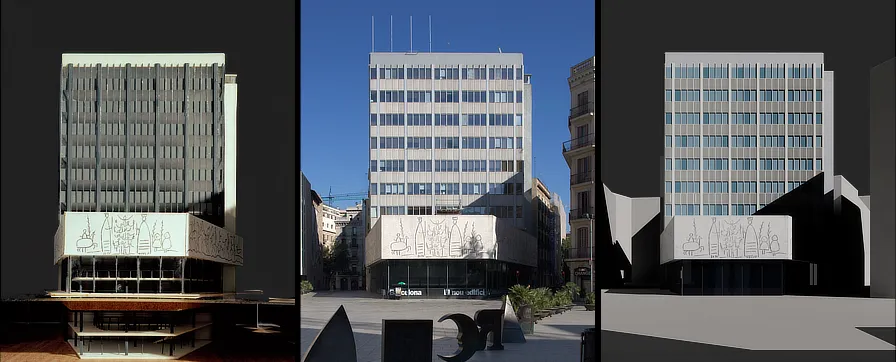
In their book Dibujo y Proyecto, Ching and Juroszek illustrate how to determine and draw the self-shadows and cast shadows of an architectural element based on its solar orientation (1) for a specific location, day, and time. Applying this light analysis methodology in 1999, during my doctoral work at ETSAB (2), I photographed the scale model of the COAC (3) in Barcelona within a studio setting. The aim was to simulate and photographically document the solar illumination (4) that the building would receive during the solstices and equinoxes. To achieve this, I illuminated the model with a spotlight (5) to emulate the parallel rays of sunlight.
Subsequently, during the 2009/2010 academic year, Guifré de Peray's (6) Final Degree Project delved further into this line of study. Based on numerical proportionality calculations derived from those model photographs (considering viewpoint, optics, and illumination), his project involved a dual process over a year: on the one hand, photographing the actual COAC building, and on the other, generating CGI (Computer-Generated Imagery) of its virtual model, thereby allowing a comparison between the two representations.
This type of study concerning the representation of sunlight has benefited enormously from technological evolution. During the analogue era of photography, solar path calculations were performed manually using diagrams. Later, incorporating these trajectories into 3D software significantly simplified these calculations. Currently, tools such as the PhotoPills (7) application allow this information to be obtained almost instantaneously, facilitating both photographic planning and architectural visual simulation.
Keywords
References
Texts
- 1. Ching, F; Jurossek, S. (1999). Dibujo y Proyecto. México: Ediciones G.Gili, S.A.. (Títol original: Design Drawing). P. 165.
“[…] Rayo de luz. La línea o haz estrecho con que la fuente irradia luz. Los rayos de luz procedentes del sol viajan 150 millones de kilómetros hasta alcanzar la superficie terrestre. El sol es una fuente tan inmensa y lejana que los rayos de luz se consideran paralelos… Ángulo solar. Dirección de los rayos solares medida en función del rumbo y la altitud. Rumbo. Dirección horizontal expresada en grados este u oeste dirección norte o sur magnético o verdadero. Azimut. Ángulo de desviación horizontal, medido en sentido horario, de un rumbo según una dirección norte estándar. Altitud. Elevación angular de un cuerpo celeste sobre el horizonte […]”
- 2. ETSAB [en línia]. ETSAB - Escola Tècnica Superior d’Arquitectura de Barcelona. Disponible a: < https://etsab.upc.edu/ca> (Data Consulta: 24 de maig 2024)
Escola Tècnica Superior d'Arquitectura de Barcelona UPC)
- 3. COAC [en línia]. COAC. Disponible a: < https://www.arquitectes.cat/ca> (Data Consulta: 24 de maig 2024)
Col·legi d’Arquitectes de Catalunya
- 6. Peray de, G. Estudi de les trajectòries solars en la imatge d’arquitectura: Fotografía i CGI. Bover, A. (Director). TFG, Centre de la imatge i la Tecnologia Multimèdia, UPC, 2010.
- 7. PhotoPills [en línia]. Shoot legendary photos. Disponible a: < https://www.photopills.com/> (Data Consulta: 24 de maig 2024)
Images
- Bover, A. Fotografia d’urbanisme: anàlisis de la imatge fotográfica en la comunicación visual d’un espai urbà. Regot, J. (Director). Tesi doctoral, Departament d’Expressió Gràfica Arquitectònica, UPC, 2011.
Toni Bover. Model COAC Barcelona. 1999.
- Peray de, G. Estudi de les trajectòries solars en la imatge d’arquitectura: Fotografía i CGI. Bover, A. (Director). TFG, Centre de la imatge i la Tecnologia Multimèdia, UPC, 2010.
Guifré de Peray. Building and virtual model COAC Barcelona. 2009/2010.