089
The digital panoramic image (L'illa Diagonal, Barcelona)
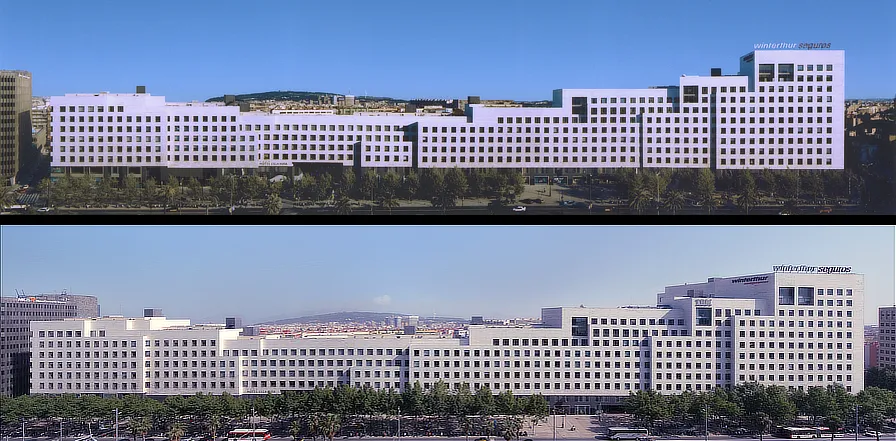
From the beginnings of photography, panoramic cameras (1) were designed based on the principles of curvilinear perspective (2). Panoramic photography underwent a significant transformation with the advent of digital imaging, largely due to the development of image stitching software and the ability to attach panoramic heads (3) to tripods, which allow the camera to rotate around the nodal point (4) of the lens.
As an example, here are two panoramic approaches to the L'illa Diagonal building in Barcelona. It is a kind of horizontal “skyscraper” that faces north-east and receives ample sunlight around the summer solstice. During his Final Degree Project in 2001, Carles Climent (5) photographed the building using analogue film from four different viewpoints over three days. In 2007, for my doctoral thesis (6), I photographed the same building from a single viewpoint, using a digital camera mounted on a panoramic head.
While the result of the first project reflects the four original viewpoints, the stitching software in the second case enabled the joining of various captured images into a single rectilinear panorama. This software proportionately merged the pixels from each photograph to create an image with a unified perspective and a single principal point (7) in the final result.
References
Texts
- 1. Auer, M. (1975) Histoire Illustrée des Appareils Photographiques. Lausanne: Denoël.
- 2. Kemp, M. (2000) La Ciencia del Arte: La óptica en el arte occidental de Brunelleschi a Seurat. Madrid: Ediciones Akal, S.A. (Títol original: The Science of Art.1990)
- 3. Bover, A. Fotografia d’urbanisme: anàlisis de la imatge fotográfica en la comunicación visual d’un espai urbà. Regot, J. (Director). Tesi doctoral, Departament d’Expressió Gràfica Arquitectònica, UPC, 2011. P. 149.
“Totes les ròtules panoràmiques tenen mètodes de cerca del punt nodal anterior, basats en tests visuals en què es posen dos elements de referència (un de proper i l’altre de llunyà respecte de la càmera) i es va desplaçant i girant la càmera amb les regletes, fins que les obstruccions visuals entre els dos elements visuals de referència no varien en girar la càmera. Quan les obstruccions visuals no canvien en girar la càmera, vol dir que l’objectiu que s’està utilitzant gira respecte del punt nodal anterior”.
- 4. Collins [en línia]. Nodal point. Disponible a: <https://www.collinsdictionary.com/es/diccionario/ingles/nodal-point> (Data Consulta: 26 de maig 2024)
“Nodal point. Either of two points on the axis of a lens or other optical system, determined by extending an incident oblique ray and the corresponding refracted ray to the axis for the pair of rays that are parallel outside the optical system”.
- 5. Climent, C. L'illa Diagonal. Bover, A. (Director). TFG, Centre de la imatge i la Tecnologia Multimèdia, UPC, 2001.
- 6. Bover, A. Fotografia d’urbanisme: anàlisis de la imatge fotográfica en la comunicación visual d’un espai urbà. Regot, J. (Director). Tesi doctoral, Departament d’Expressió Gràfica Arquitectònica, UPC, 2011.
- 7. Ching, F; Jurossek, S. (1999) Dibujo y Proyecto. México: Ediciones G.Gili, S.A.. (Títol original: Design Drawing). P. 225.
“Perspectiva de un punto de fuga. Si vemos un cubo de tal modo que el rayo principal sea perpendicular a una de sus caras, las aristas verticales son paralelas al plano del cuadro y conservan la verticalidad. Las rectas horizontales paralelas al plano del cuadro y perpendiculares al rayo visual principal permanecen horizontales, pero las rectas paralelas al rayo visual principal convergerán hacia el punto principal, punto al que hace referencia a la denominación de esta clase de perpectiva”.
Images
- Fusion of four 6x7 cm slides, captured from four different points of view, from the three buildings in front of the L'illa Diagonal, on three consecutive days at the same time. Because of the distance and the logistics of accessing the terraces of the three buildings, it was not feasible to take all the images in one day. As the L'illa Diagonal building faces north-east, it was photographed around the summer solstice. An View Camera Technique was used to compose with the camera movements a frontal perspective in each of the photographs. The resulting slides were digitised in a scanner and by digital post-production the tonalities and colour of the photographs were matched, and the four digital images were manually merged.
- Fusion of three images, captured from the same point of view, with a 23.7 x 15.6 mm digital camera. The photographs were taken from the terrace of the central building in front of L'illa Diagonal, on a date close to the summer solstice. The camera was mounted on a tripod with a panoramic head, to be able to rotate the three images from the nodal point of the lens. By digital post-production, using panoramic image creation software, a frontal perspective panorama was created with a single vanishing point in the final picture.