091
Panoramic images as spectacle (R. Barker & Poor Things)
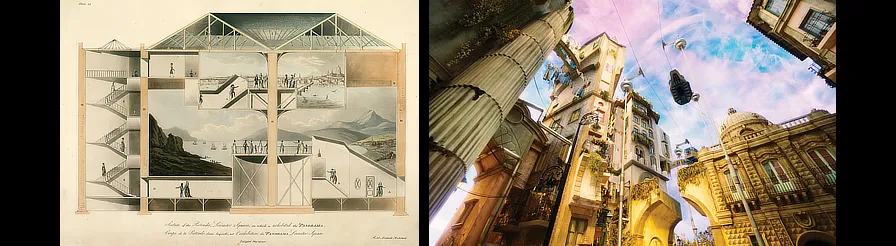
From a historical perspective, in the 17th century, Kepler (1) designed a camera obscura that would later be used for the creation of panoramas. Panoramas (2) were large-scale pictorial representations on a cylindrical support, depicting historical themes or urban landscapes. These images were created separately and then fused pictorially (a precursor to stitching software) (3). These large murals were illuminated with natural light, and the spectators walked around them in half-light (another way of understanding the Dimension of Time).
From the 19th century onwards, rotating cameras were built to create 360º cylindrical images. As an example, the Lumière brothers produced the Périphote (4) camera to later create the Photorama (5), a photographic cylinder in which the viewer was placed inside. The evolution of technology allowed for the construction of optics with a 180° field of view (Fisheye lens) (6) and 360° digital video cameras. Its application as a spectacle can be seen, for example, in the film Poor Things (7).
References
Texts
- 1. Kemp, M. (2000). La Ciencia del Arte: La óptica en el arte occidental de Brunelleschi a Seurat. Madrid: Ediciones Akal, S.A. (Títol original: The Science of Art.1990). P. 203-204.
- 2. Comment, B. (1999). The Panorama. London: Reaktion Books.
- 3. 090 L’instant decisiu en la fusió d’imatges / The decisive moment in the merging of images
- 4. Auer, M. (1975) Histoire Illustrée des Appareils Photographiques. Lausanne: Denoël. P. 267.
Frères Lumière. Périphote. 1901.
- 5. Institut Lumière [en línia]. Le Photorama Lumière. Disponible a: <https://www.institut-lumiere.org/musee/les-freres-lumiere-et-leurs-inventions/photoramas.html> (Data Consulta: 30 de maig 2024)
- 6. Stroebel L.; Zakia R. (1993) Encyclopedia of Photography. Third Edition. Boston, London: Focal Press. P. 432.
“Fisheye lens. A lens with extreme angle of coverage. The geometry of orthoscopic image formation and image illumination limit the angle of coverage of a distortion-free lens to about 120 degrees. If barrel distortion is permissible, then the angle can be increased to 180 degrees or more”.
- 7. filmaffinaty [en línia]. Poor Things. 2023. Disponible a: < https://www.filmaffinity.com/es/film270023.html > (Data Consulta: 30 de maig 2024)
Images
- The Velaslavasay Panorama [en línia]. History: A Concise History of Panorama. Disponible a: <https://www.panoramaonview.org/history> (Data Consulta: 29 de novembre 2024)
Section of Burford’s Panorama, Leicester Square. From Robert Mitchell’s Plans and Views in Perspective of Building Erected in England and Scotland, 1801.
- CQ: Xuanlin Tham (2024) [en línia]. Pobres criaturas y su diseño de arte y producción: interruptores en forma de clítoris, animales híbridos y cerebros rebanados. Disponible a: <https://www.revistagq.com/articulo/pobres-criaturas-diseno-arte-produccion> (Data Consulta: 28 de maig 2024)
Picture of the film.