093
Utopian architecture and The belly of an architect (Étienne-Louis Boullée & Peter Greenaway)
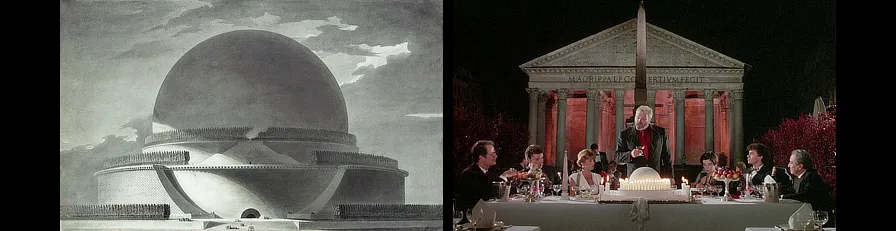
For years, cinema and television series have transformed urban spaces into cinematic backdrops. Some cities are more photogenic than others, and Rome has become one of the most iconic. This is the city that filmmaker Peter Greenaway (1) used to pay tribute to the utopia of one of the most revolutionary architects of the 17th century, Étienne-Louis Boullée (2), in the film The Belly of an Architect (3).
From a historical perspective, one of the aesthetic characteristics of utopian architects was the use of frontal perspective. Greenaway, evoking Boullée's style, filmed the classical and neoclassical buildings of Rome in a frontal manner. From the perspective of cinema as a concept, Greenaway constructs a linear audiovisual narrative in the form of a network, incorporating visual references to art and classical culture. In the realm of fiction, the film tells a parallel story between the way the protagonist—a North American architect—understands architecture and the utopian vision of the French architect Boullée. Finally, from the duality of death/life (4), the film’s title takes on a symbolic meaning: while death takes root in the architect’s belly, life germinates in his wife’s belly.
Keywords
References
Texts
- 1. Gorostiza, J. (1995). Peter Greenaway. Madrid: Cátedra, cop.
- 2. filmaffinaty [en línia]. The Belly of an Architect. 1987. Disponible a: < https://www.filmaffinity.com/es/film122488.html > (Data Consulta: 3 de juny 2024)
- 3. Kaufmann, E. (1980). Tres arquitectos revolucionarios: Boullée, Ledoux y Lequeu. Barcelona: Gustavo Gili Ed. (Títol original: Three revolutionary architects: Boullée, Ledoux and Lequeu)
- 4. 098 El bucle visual mort/vida/ The visual death/life loop
Images
- BNF [en línia]. Le Cénotaphe de Newton. 1784. Disponible a: <http://expositions.bnf.fr/utopie/grand/2_92.htm > (Data Consulta: 3 de juny 2024)
Architect Boulée's utopian project dedicated to the memory of Isaac Newton. Boulée designed perforated holes in the vault of the building, which would filter the natural lighting and give the impression that they were stars shining through the light.
- FILMGRAB [en línia]. The Belly of an Architect. 1987. Disponible a: <https://film-grab.com/2020/11/24/the-belly-of-an-architect/ > (Data Consulta: 3 de juny 2024)
Film frame with a cake in the shape of Boulée's Paris Opera project, 1781; in front of a frontal perspective image of the Pantheon of Agrippa, in the Piazza della Rotonda in Rome.